









What Is a Battery Power Station and How Does It Work?
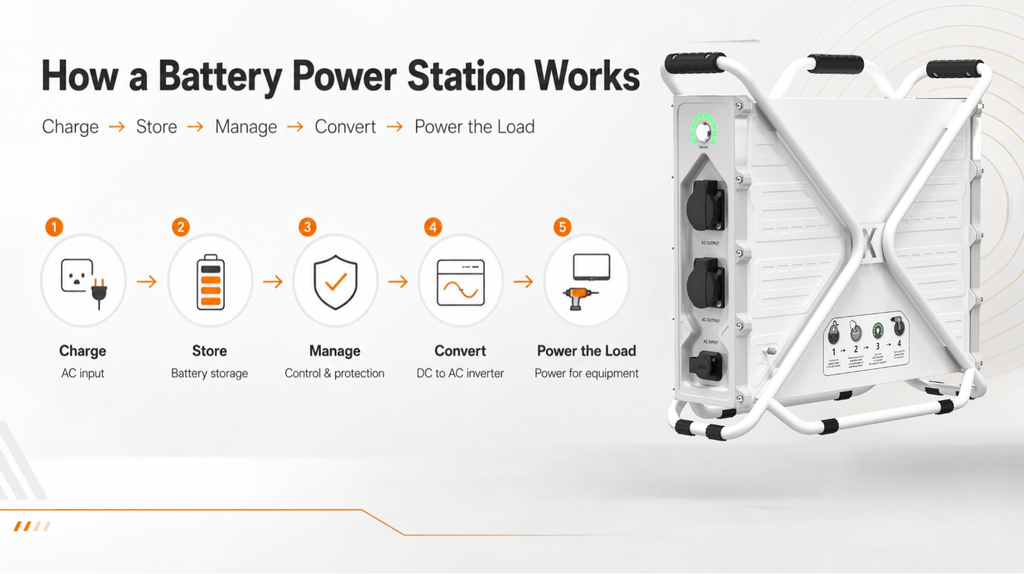
A battery power station is a rechargeable energy-storage system that stores electricity and supplies it later through AC or other electrical outputs. Unlike a fuel generator, it does not produce electricity by continuously running an engine. Instead, electrical energy is charged into a battery, stored as DC power, managed by control and protection electronics, and converted into usable AC power when equipment is connected.
For professional users, understanding how a battery power station works is important because battery capacity alone does not determine what equipment it can run. Output power, stored energy, startup demand, overload duration, voltage, waveform and operating conditions all affect real-world performance.
In simple terms:
Charge → Store → Manage → Convert → Power the Load
That principle applies whether the system is supporting electronics, professional lighting, maintenance equipment, power tools or other temporary off-grid loads.
What Is a Battery Power Station?
A battery power station is an integrated electrical system that combines energy storage, power conversion, charging electronics, protection functions and output connections in one portable or mobile unit.
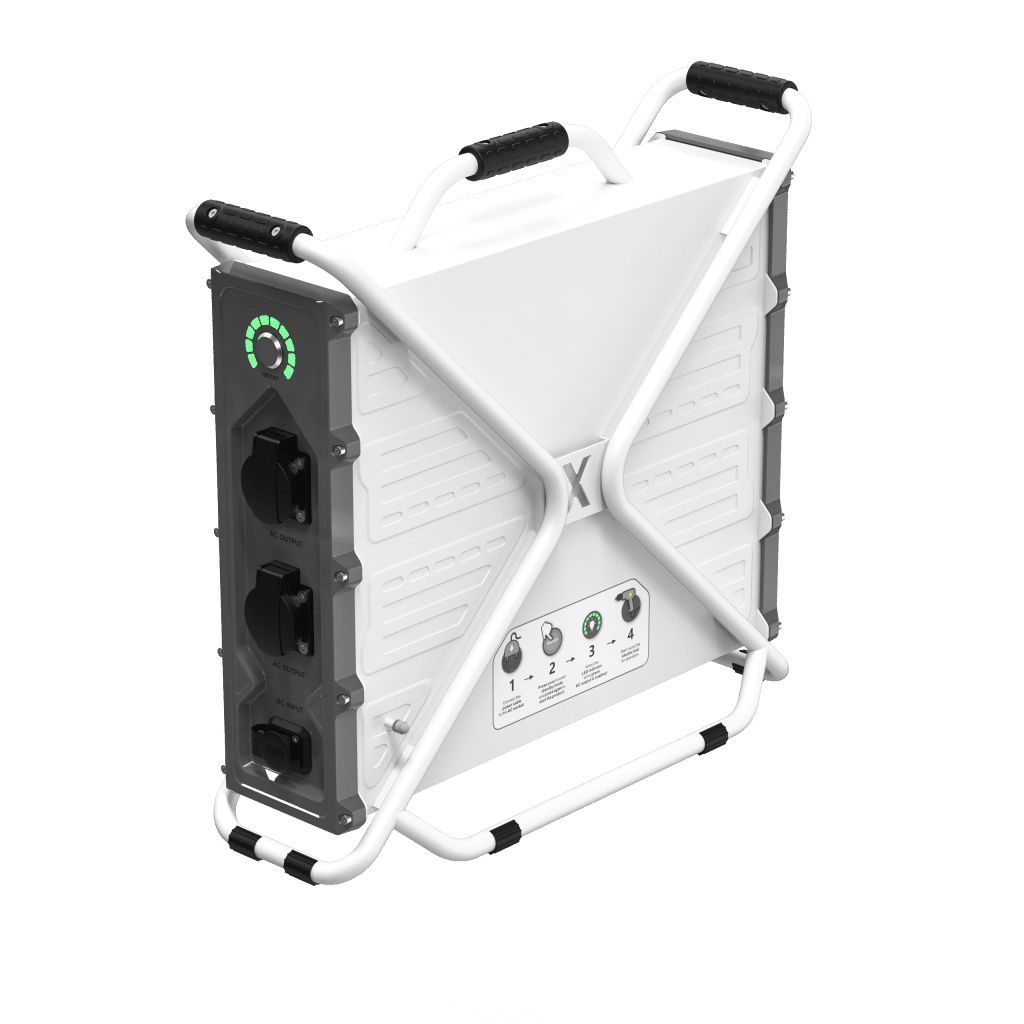
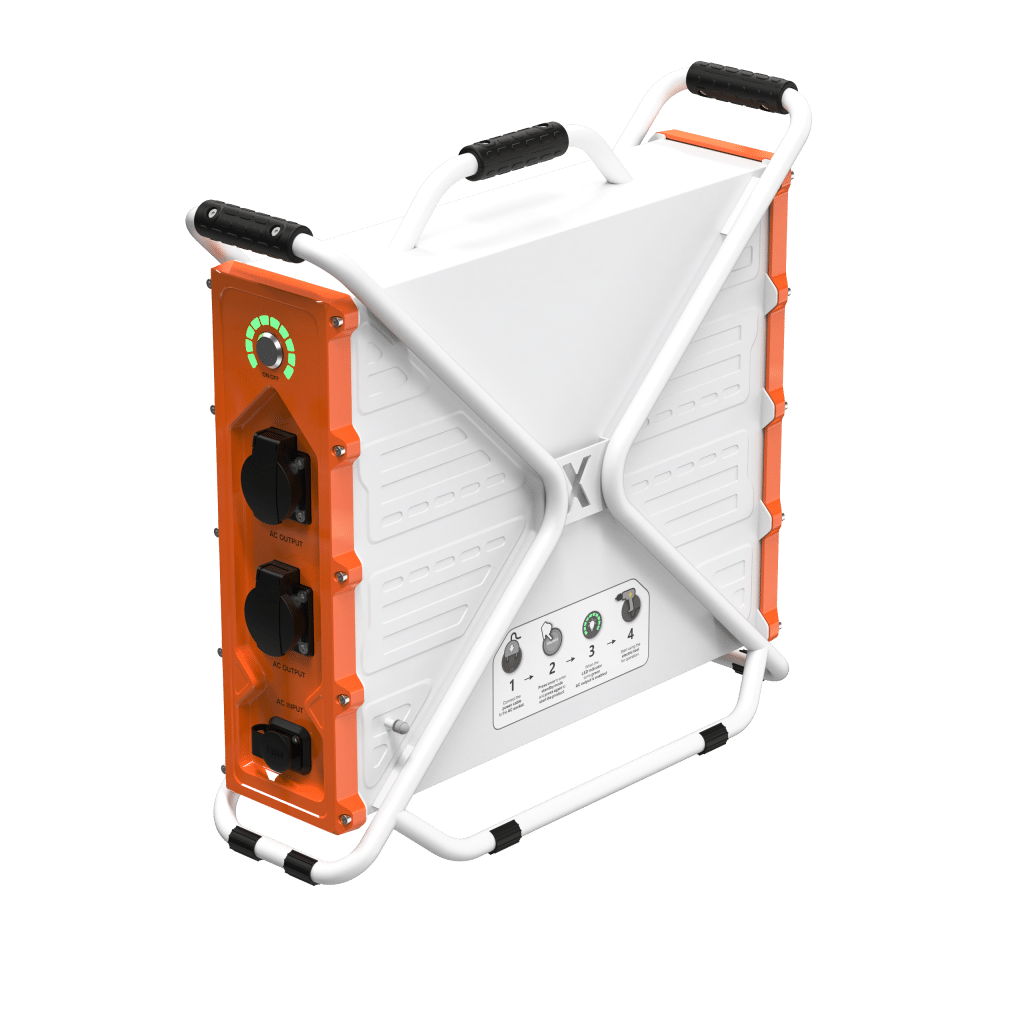
It differs fundamentally from a conventional gasoline or diesel generator.
A fuel generator converts chemical energy from fuel into mechanical energy through an engine and then into electricity through an alternator. A battery power station already contains stored electrical energy, so no combustion engine needs to run while the battery is supplying power.
This distinction has practical implications.
Battery systems can be particularly useful where mobility, low operating noise and avoiding combustion exhaust near the working area are important. Fuel generators may remain practical when very long continuous runtime is required and regular battery recharging is not available.
How Does a Battery Power Station Work?
Although modern systems contain sophisticated electronics, the underlying energy flow is relatively straightforward.
1. Electricity Enters the Power Station
The first step is charging.
Electricity enters through a compatible charging input. Depending on the particular power station, this may come from an AC mains supply or other supported charging sources.
Charging electronics control the incoming voltage and current so that energy can be stored within the battery system’s permitted operating limits.
For example, the EU configuration of the Fullas FPG3600 is designed around a 230Vac rated input, with an input voltage range of 176–264Vac and a maximum input power of 1200W.
2. The Battery Stores Energy as DC Power
Once electricity enters the system, energy is stored in the battery as direct-current electrical energy.
Battery storage capacity is normally expressed in watt-hours (Wh). (U.S. Department of Energy — Battery Storage)
A 2304Wh battery, for example, represents 2304 watt-hours of nominal stored energy.
This figure tells you about available energy, but it does not tell you how much instantaneous power the system can deliver.
That distinction is one of the most important concepts in understanding battery power stations.
3. Control and Protection Systems Manage the Energy
A battery power station is more than a battery connected directly to an outlet.
Control and protection electronics monitor the way electrical energy enters, leaves and moves through the system.
Depending on the design, these systems can monitor conditions such as:
- voltage;
- current;
- temperature;
- charging and discharging status;
- overload conditions;
- short-circuit or abnormal operating conditions.
This management layer helps keep the battery and power electronics within their intended operating limits.
4. The Inverter Converts DC Power Into AC Power
Batteries store electrical energy as DC — direct current.
Most professional AC equipment, however, requires AC — alternating current.
The inverter is therefore one of the most important parts of an AC battery power station.
It converts the stored DC electricity into AC electricity at the voltage and frequency required by the connected equipment.
For example, the FPG3600 industrial portable power station provides a 230Vac pure sine wave output at 50Hz.
The picture shows Fullas presenting the usage process of FPG3600 at the 139th Canton Fair.


Pure sine wave output is particularly relevant when supplying AC equipment because the waveform is designed to resemble conventional mains AC rather than a coarse modified waveform. (Fluke — Understanding Power Quality).
5. Electricity Is Delivered to the Connected Load
After conversion, electricity is delivered through the power station’s output connection to the equipment.
While this happens, the system must continuously respond to the load.
If the equipment remains within the normal rated output, the power station can continue supplying it until the battery reaches its discharge limit or operation is stopped.
If the equipment temporarily demands more power — which can happen when motors, compressors or certain professional loads start — the power station must decide whether that temporary demand is within its permitted overload range.
This is where rated power and surge power become important.
What Are the Main Parts of a Battery Power Station?
A typical portable battery power station contains several functional systems working together.
| Component | Main Function |
| Battery pack | Stores electrical energy as DC |
| Charging system | Controls incoming charging energy |
| Power inverter | Converts DC battery power into AC output |
| Protection and control electronics | Monitor electrical and thermal operating conditions |
| Output system | Delivers electricity to connected equipment |
| Indicators or monitoring system | Shows battery and operating status |
| Cooling system | Helps manage heat produced by power electronics |
The exact architecture varies between manufacturers and models.
Battery chemistry should also not be assumed from the phrase “battery power station.” Different systems can use different cell technologies, and buyers should check the manufacturer’s actual technical documentation.
Watts vs Watt-Hours: What Is the Difference?
One of the most common mistakes when comparing battery power stations is treating watts and watt-hours as if they mean the same thing.
They do not.
Watts (W) measure power. Watt-hours (Wh) measure stored energy.
A simple way to think about the difference is:
Watts = how much power can be delivered
Watt-hours = how much energy is available
For example, consider a battery power station with:
- 3600W rated output
- 2304Wh battery capacity
The 3600W figure describes how much continuous electrical load the system is rated to supply.
The 2304Wh figure describes the amount of stored battery energy.
A 2304Wh battery does not mean the power station can only output 2304W.
Likewise, a 3600W inverter does not mean the battery contains 3600Wh of stored energy.
Professional buyers need to evaluate both.
How Do You Estimate Battery Power Station Runtime?
A simple theoretical calculation is:
Runtime (hours) ≈ Battery capacity (Wh) ÷ Average load (W)
For a 2304Wh system operating a hypothetical constant 1000W load:
2304Wh ÷ 1000W = 2.304 hours
But this is a theoretical value, not a guaranteed runtime.
Real-world operating time can be affected by:
- inverter conversion losses;
- internal system consumption;
- changing equipment load;
- battery operating limits;
- temperature;
- tool duty cycle;
- startup events.
This matters particularly for professional equipment.
A 1000W heater drawing a relatively steady load behaves differently from a 1000W-rated motor-driven tool that repeatedly starts, stops and changes load.
For this reason, runtime calculations should be treated as a planning estimate rather than an exact promise.
Rated Power vs Peak Power: Why It Matters
Battery power station specifications often show both rated output power and peak power.
These numbers describe different operating conditions.
Rated Output Power
Rated output is the power level the system is designed to deliver during normal continuous operation.
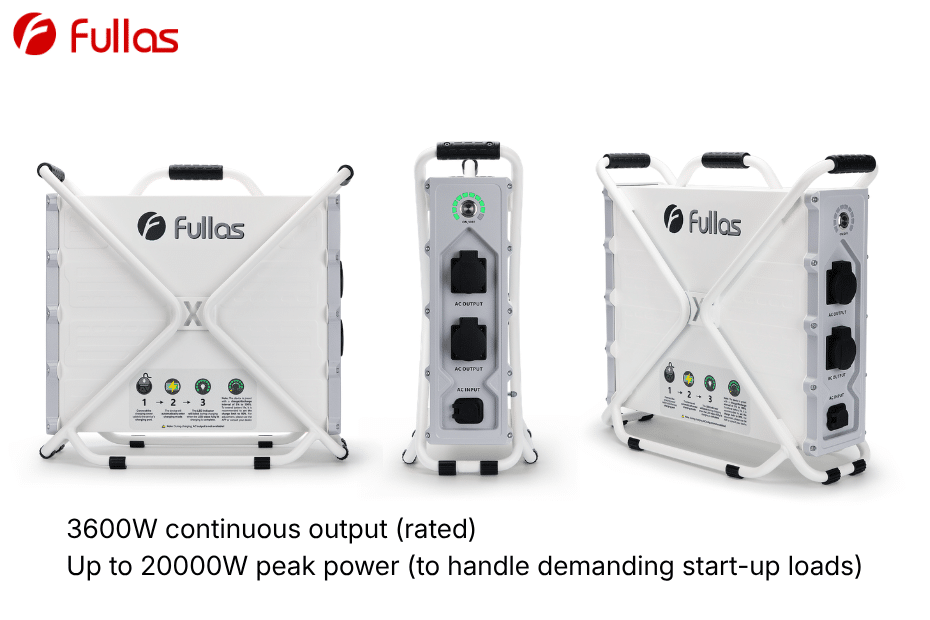
For the FPG3600, this is:
3600W rated output power.
Peak Power
Peak power describes a much shorter-duration capability used to handle temporary demand.
The FPG3600 specification lists:
Up to 20000W peak power under specified short-duration conditions.
That does not mean the unit provides 20kW continuously.
Its continuous rated output remains 3600W.
This distinction is especially important for professional equipment because a machine can momentarily demand substantially more current while starting than it consumes once it reaches normal operation.
Why Surge Duration Matters More Than the Peak Number Alone
A peak-power figure becomes much more useful when the manufacturer also explains how long an overload can be supported.
The supplied FPG3600 technical data provides the following overload bands:
| Load Range | Supported Duration |
| 4000–5400W | More than 500 seconds |
| 5400–7200W | More than 50 seconds |
| 7200–9000W | More than 10 seconds |
| Above 9000W | More than 1 second |
The system also specifies a 140A maximum instantaneous peak output current.
These figures provide more information than a 20000W headline alone.
For a professional buyer evaluating a motor, compressor, welding machine or other load with high startup demand, the relevant questions are:
How much continuous power does the machine require?
How high is its startup demand?
How long does that higher demand last?
The answers help determine whether a particular battery power station is suitable for the application.
Why Pure Sine Wave Output Matters
AC electricity is not defined only by voltage.
The shape of the AC waveform also matters.
A pure sine wave inverter produces a smooth AC waveform intended to resemble conventional mains electricity.
This can be relevant for professional electronics, control systems, chargers, lighting equipment and other devices whose performance may depend on power quality.
The FPG3600-EU specification provides:
| Output Parameter | Specification |
| Rated output voltage | 230Vac |
| Waveform | Pure sine wave |
| Output voltage range | 230 ±5Vac |
| Output frequency | 50Hz |
| Rated output power | 3600W |
| Peak power | Up to 20000W, short duration |
| No-load power consumption | ≤30W |
For equipment buyers, output compatibility should always be checked against the actual voltage, frequency, power and startup requirements of the intended load.
How Is a Battery Power Station Recharged?
Once its stored energy has been used, the battery must be recharged.
Charging time depends primarily on:
battery capacity + permitted charging power + charging conditions
The detailed FPG3600 input specification provides a useful example.
| Input Parameter | FPG3600-EU |
| Rated input voltage | 230Vac |
| Input voltage range | 176–264Vac |
| Input frequency range | 45–65Hz |
| Maximum input power | 1200W |
| Rated input current | 6A |
| Maximum input current | 8A |
The current FPG3600 product information specifies approximately 2.5 hours of charging time under the stated product configuration and conditions.
Charging specifications are important to professional users because a large battery with slow charging can create operational downtime.
For equipment-rental businesses or field teams, recharge time can therefore be almost as important as total battery capacity.
Operating Conditions Matter Too
Professional battery power stations may operate in more demanding environments than consumer power banks.
For this reason, buyers should look beyond W and Wh.
The supplied FPG3600 parameter sheet lists:
| Environmental Parameter | Specification |
| Charging temperature | 5°C to 40°C |
| Discharging temperature | -15°C to 55°C |
| Storage temperature | -20°C to 60°C for 1 month |
| Longer storage temperature | -20°C to 45°C for 3 months |
| Operating humidity | 10–90% RH |
| Storage humidity | 5–95% RH |
| Operating altitude | Up to 2000m |
| Protection rating | IP54 |
| Cooling | Natural cooling |
IP54 should not be interpreted as “waterproof.”
It describes a defined level of protection against limited dust ingress and water splashes. [ IEC 60529 — Degrees of protection provided by enclosures (IP Code) ]
It describes a defined level of protection against limited dust ingress and water splashes. Equipment should still be used according to its specified environmental limits.
How Does the FPG3600 Apply These Principles?
The Fullas FPG3600 provides a practical example of how a professional battery power station combines storage, power conversion and load management.
Its key specifications include:
| Specification | FPG3600 |
| Battery capacity | 2304Wh |
| Rated output power | 3600W |
| Peak capability | Up to 20000W under short-duration conditions |
| Output | 230Vac pure sine wave for EU configuration |
| Output frequency | 50Hz |
| Protection rating | IP54 |
| Net weight | 23.8kg in the supplied technical sheet |
| Dimensions | 526 × 485 × 211mm |
| Cooling | Natural cooling |
| Maximum input power | 1200W |
| Peak output current | 140A maximum instantaneous value |
| No-load consumption | ≤30W |
| Indicator | 10-level ring indicator |
The current Fullas product page rounds the weight to approximately 24kg, while the detailed parameter sheet provides 23.8kg.
The important point is not that a battery power station has one unusually large specification. Its real capability comes from the relationship between battery capacity, continuous output, short-duration overload capability, power quality and operating conditions.
Real-World Example: Battery Power for Film Production in New Zealand
The way a battery power station works becomes easier to understand when viewed through an actual application.
A practical example of battery power station application can be seen in a commercial film production project in New Zealand. The battery power solution used for film production demonstrates how portable energy storage can support professional production environments where mobility and low noise are important.

During a commercial shoot on New Zealand’s rugged coastline, a production crew used an FPG3600 as a portable power source alongside professional filming equipment.
The filming location presented several practical challenges.
Grid electricity was not readily available near the shooting area, while cameras, monitors, lighting systems, charging equipment and other production hardware still required electricity.
A conventional generator could have provided electrical power, but it would also have introduced engine noise, exhaust and additional fuel logistics.
The FPG3600 was positioned closer to the crew’s equipment so that electrical power could be brought to the point of use rather than forcing the production setup to remain close to a fixed electrical source.
This illustrates one of the practical advantages of stored battery energy:
The power source can move with the work.
For film production, this can be particularly valuable because camera and lighting positions may change throughout the day.
The FPG3600 operates at less than 30dB under specified conditions, helping reduce power-source noise around a sound-sensitive production environment.

Its approximately 24kg portable frame also allowed the unit to be moved around the rocky location as the production setup changed.
This New Zealand application demonstrates that the value of a professional battery power station is not simply its Wh rating.
It is the combination of:
stored energy + usable AC output + mobility + low operating noise + compatibility with the required equipment.
Where Are Professional Battery Power Stations Used?
The same operating principle can support a range of professional applications.
Construction and Temporary Jobsites
A battery power station can provide temporary electricity for compatible power tools, lighting and maintenance equipment where grid access is limited.
For motor-driven equipment, startup current and overload capability should be checked carefully.
Field Service and Maintenance
Technicians working away from fixed infrastructure may need electricity for diagnostic equipment, tools, chargers or temporary repair operations.
Portability and recharge time become important because the power source may need to move between jobs.
Film and Photography Production
Cameras, monitors, lighting equipment and charging systems often need mobile power in locations where generator noise or long extension cables are undesirable.
Battery systems can be positioned closer to the production area because there is no running combustion engine.
Equipment Rental
Rental companies need to evaluate more than battery capacity.
Useful criteria include:
- continuous output;
- overload behaviour;
- charging turnaround;
- transportability;
- environmental protection;
- regional voltage configuration;
- application compatibility.
Remote Professional Work
Inspection, repair, infrastructure and technical teams frequently operate where permanent grid power is unavailable.
A portable battery system can provide temporary power without requiring a generator to operate continuously beside the worker.
What Should B2B Buyers Check Before Choosing a Battery Power Station?
For professional sourcing, comparing only battery capacity is not enough.
A more complete technical evaluation should include:
| Buying Criterion | Why It Matters |
| Battery capacity (Wh) | Determines stored energy |
| Rated output (W) | Determines sustainable load |
| Surge capability | Helps support temporary high-demand loads |
| Surge duration | Shows how the system handles overloads |
| Voltage | Must match the equipment and target market |
| Frequency | Must match connected AC equipment |
| Waveform | Relevant for AC power quality |
| Charging power | Affects recharge time |
| Operating temperature | Determines environmental suitability |
| IP rating | Indicates environmental protection |
| Weight and dimensions | Affect field mobility |
| Safety/protection system | Relevant to professional operation |
| Certifications | Important for import and market evaluation |
For distributors and OEM buyers, certification scope should also be verified for the intended market rather than assuming that the presence of a standard automatically covers every application.
Battery Power Station vs Battery: What Is the Difference?
A battery alone stores energy.
A battery power station is a complete power system.
It typically combines storage with power conversion, charging control, protection, outputs and monitoring.
This distinction explains why two products containing similar amounts of stored energy can have very different capabilities.
One may support high-power AC loads.
Another may have limited inverter output.
One may tolerate demanding startup loads.
Another may shut down when the same machine starts.
Therefore, professional buyers should never evaluate a power station solely from battery capacity.
Battery Power Station vs Power Bank: Are They the Same?
They follow a similar basic principle — both store electrical energy — but they are designed for very different power levels and applications.
A conventional power bank is primarily designed to charge low-voltage electronic devices.
A battery power station integrates substantially higher-capacity energy storage and power-conversion electronics so it can supply AC equipment and higher-power loads.
For B2B and industrial use, the important distinction is not the physical size of the battery.
It is the electrical capability of the entire system.
Frequently Asked Questions
How does a battery power station work?
A battery power station stores electrical energy as DC power inside a rechargeable battery system. When AC equipment is connected, an inverter converts the stored DC electricity into AC electricity at the required voltage and frequency, while control and protection electronics manage the system during charging and discharging.
What does Wh mean on a battery power station?
Wh means watt-hours and measures stored energy.
A 2304Wh battery contains a nominal 2304 watt-hours of stored energy. It does not mean that the system can only produce 2304W of output power.
What does W mean on a battery power station?
W means watts and describes power.
For example, the FPG3600’s 3600W rated output describes its continuous output capability, while its 2304Wh figure describes battery capacity.
Is 20000W the continuous output of the FPG3600?
No.
The FPG3600 has a 3600W rated continuous output. The stated 20000W figure refers to its maximum short-duration peak capability and should not be interpreted as continuous 20kW output.
Can a battery power station run professional power tools?
Yes, if the system’s voltage, continuous output and short-duration startup capability are compatible with the tool.
Professional users should check both normal operating power and startup or inrush demand before connecting motor-driven equipment.
Can a battery power station be used for film production?
Yes, compatible professional battery systems can supply cameras, lighting, monitors and charging equipment.
Fullas has documented an FPG3600 being used during a commercial shoot on New Zealand’s coastline, where portable, low-noise power was required close to the production equipment.
Conclusion
A battery power station works by charging electrical energy, storing it in a battery, managing that stored energy and converting it into usable power when equipment needs it.
Understanding this process also explains why professional buyers should look beyond battery capacity.
The most important specifications work together:
Wh tells you how much energy is stored.
W tells you how much power can be supplied.
Surge capability tells you how the system handles temporary high loads.
Voltage, frequency and waveform determine electrical compatibility.
Charging and operating conditions determine how practical the system is in real work.
For professional applications such as construction, field maintenance, equipment rental and film production, a battery power station should therefore be evaluated as a complete electrical system — not simply as a large rechargeable battery.
Fullas provides a range of industrial portable power stations designed for professional temporary power, off-grid applications and equipment users.
The Fullas FPG3600 is one example of this approach, combining 2304Wh of stored energy with 3600W rated AC output, documented short-duration overload capability, pure sine wave power and an industrial portable format for temporary and off-grid applications.