









Construction Site Power Supply: Complete Guide for Contractors in 2026
Construction Site Power Supply: Complete Guide for Contractors in 2026
Reliable Construction Site Power Supply is no longer just a question of “how many watts do you need.” On modern job sites, the real questions are more specific: can the power source start high-inrush tools, keep voltage stable under load, work safely indoors, tolerate dust and light rain, move easily between work zones, and support real construction tasks instead of only lights and chargers. Temporary wiring on construction sites must also be managed correctly and removed when the work is done, and shock protection such as RCDs (Residual Current Devices) remains a core safety requirement on many job sites.
For contractors, this means the best construction site power setup is not always the biggest generator. In many cases, the better solution is the one that matches actual site conditions: renovation, interior fit-out, maintenance work, punch-list work, noise-sensitive areas, enclosed spaces, early-stage temporary power, or mobile crews rotating between tools. In those scenarios, stable battery-based jobsite power can be more practical than fuel-based equipment because it reduces noise, eliminates exhaust emissions at the point of use, and simplifies movement between tasks.
What a construction site power supply actually needs to do
A serious Construction Site Power Supply must answer five practical demands. It must deliver stable output voltage for sensitive and motor-driven tools. It must tolerate surge loads when tools start. It must provide enough usable energy, not just rated power. It must survive site conditions such as dust, transport vibration, changing temperatures, and intermittent use. It must also be easy to deploy, store, recharge, and manage.
This is where many contractors make poor buying decisions. They compare only “rated power” and ignore overload behavior, battery capacity, recharge time, ingress protection, operating temperature, no-load consumption, and what the unit can really do in field tests. A power source that looks strong on paper but cannot support actual cutting, drilling, welding, pumping, or demolition work is not a real jobsite solution.


The most important numbers to check before choosing a jobsite power source
For 2026, the right way to evaluate Construction Site Power Supply is to look at six core numbers together.
The first is rated output power. This tells you what the machine can support continuously. The second is overload capability. Many construction tools do not just need steady running power; they need high starting current. The third is battery capacity, because runtime matters as much as output. The fourth is peak power, which determines whether the system can handle instant load spikes. The fifth is environmental suitability, such as IP rating and working temperature. The sixth is charging performance, because a unit that takes too long to recover can slow down the entire crew.
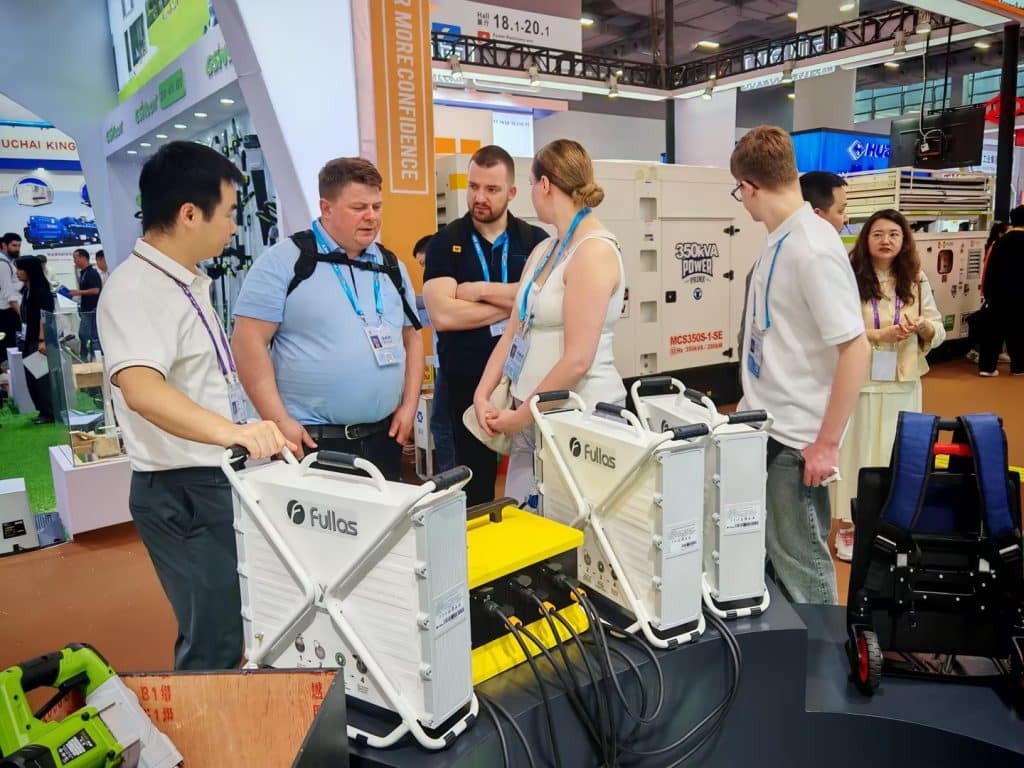
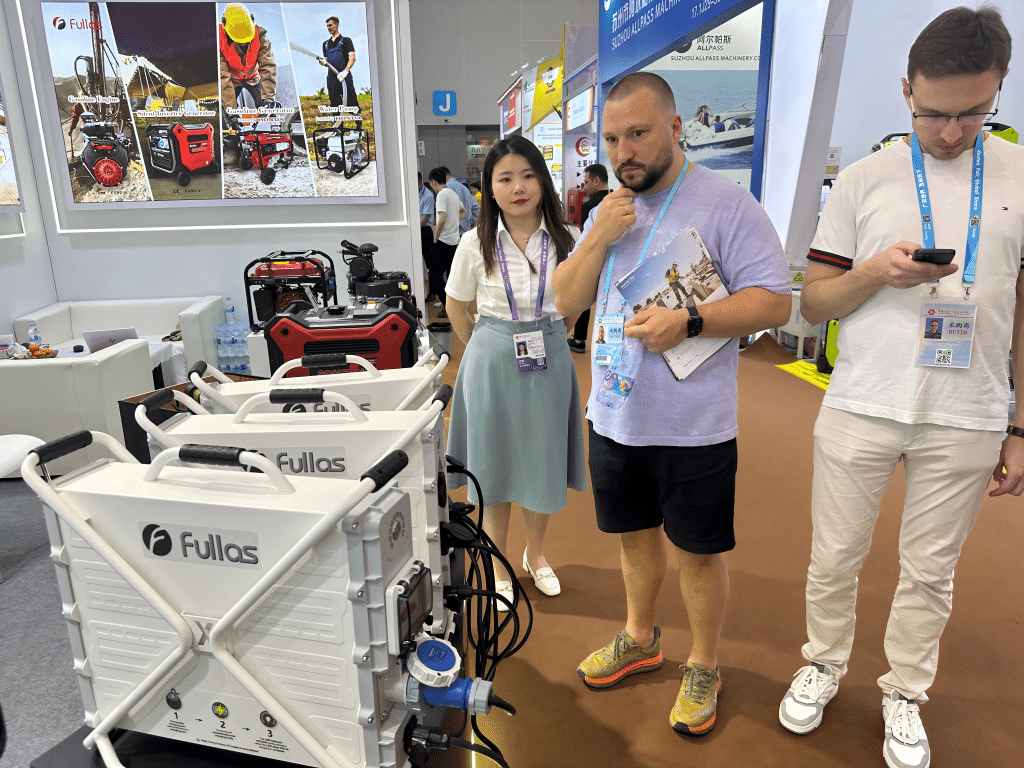
Using those criteria, the FPG3600 is much easier to evaluate in real construction terms. It delivers 3,600W rated output, 20,000W peak power, 2304Wh capacity, 230V pure sine wave output, IP54 protection, and 1200W max input power. It also supports overload bands rather than only a single cutoff point: 4000W–5400W for more than 500 seconds, 5400W–7200W for more than 50 seconds, 7200W–9000W for more than 10 seconds, and above 9000W for more than 1 second. That matters on site because real tools rarely behave like clean laboratory loads.
Clear answer: how much load can the FPG3600 handle?
The direct answer is this: the FPG3600 is designed for 3,600W rated output, with 20,000W peak power for instant surge demand. In practical use, that means it is suitable for many demanding construction tools that need strong startup support rather than just high continuous draw.
Its output is 230V pure sine wave, with 230±5V voltage range and 50±0.5Hz frequency stability, which is important for contractors using professional-grade electrical equipment. Pure sine wave output is especially relevant when tools or devices are sensitive to waveform quality, and when stable power matters more than simply “having electricity.”
Clear answer: what is the battery capacity and expansion capacity?
One FPG3600 unit provides 2304Wh, which is commonly presented as 2.3kWh. For contractors who need more runtime rather than more output power, the system supports parallel expansion up to 3 units, raising total capacity to 6.9kWh. The key point is that expansion increases energy storage, not the rated output power of each unit. This makes it useful for longer shifts, rotating teams, repeated tool cycles, and temporary power continuity without moving to a bulky fuel-based setup.
Clear answer: what battery cells does it use?
The battery cell model is INR21700-40TG, a 21700-format NCA lithium cell using nickel-cobalt-aluminum chemistry. The pure cell weight is about 11kg. For buyers comparing cell choices, this is a useful detail because cell format and chemistry influence energy density, thermal behavior, and system packaging.
The energy density figure provided is about 205Wh/kg, which is below the 300Wh/kg threshold often discussed in dual-use control contexts, so it does not meet that higher threshold. For export-related discussions, that is a concrete point rather than a vague marketing statement.
Clear answer: what certifications and transport compliance does it have?
For construction buyers, especially distributors and project purchasers, compliance is part of the power-supply decision. The FPG3600 has the following certifications listed in the product parameters: IEC 62619, UN 38.3, IEC 62477, and IEC6100. In practical sales communication, it is also presented with CE and UN38.3. For shipment, the unit follows dangerous-goods transport requirements, and the stated pre-shipment standards include the International Maritime Dangerous Goods framework and SN/T0370.3-2021. The shipping battery state should be kept below 30% before dispatch.
That point is important for contractors and distributors who care about delivery readiness, customs handling, and international transport. A jobsite battery unit is not only a tool-power product; it is also a regulated lithium product, so transport discipline matters.
Clear answer: what testing does it pass before shipment?
Before shipment, the unit goes through ATE testing and is supported by a factory inspection report. This is exactly the type of answer many distributors want because it moves the conversation from general claims to defined pre-delivery checks. If a contractor is sourcing for repeated deployment across crews or rental channels, shipment testing matters because consistency matters.
Clear answer: how long does the battery last?
The stated cycle life is 800 cycles, roughly 1600 hours under the referenced conditions, with at least 80% capacity remaining after 800 cycles. There is also a practical usage note: if the unit is operated mostly within a 20% to 80% charge-discharge range, real service life can exceed the basic 800-cycle benchmark, with an estimated runtime life around 2500 hours.
This matters for contractors because jobsite usage is rarely a perfect full-cycle pattern. Many crews use power in bursts, partial discharge windows, and shift-based recharge schedules. In that kind of workflow, practical lifetime can look better than the simple cycle number suggests.
Clear answer: does it support pass-through charging?
No. The FPG3600 does not support charging and discharging at the same time. That is an important operational point and should be stated clearly. If your crew needs uninterrupted use while plugged in, plan around charging windows, spare units, or expanded-capacity configurations rather than assuming pass-through operation.
Clear answer: what are the charging specs?
The charging input is 230Vac, with 176–264Vac input range, 1200W max input power, and 6A rated input current with 8A max. The listed charging power is 1200W, with 1300W peak charging power.
For contractors, this means the unit can be recharged at a practical rate for shift turnover, but it is still important to plan charging cycles around the work schedule. On fast-moving sites, recharge planning should be treated as part of site logistics, not as an afterthought.
Clear answer: can it work in harsh temperatures?
Yes, within defined limits. The working temperature is 5–40°C for charging and -15–55°C for discharging. Storage temperature is -20–60°C for 1 month or -20–45°C for 3 months. At low temperature, lithium-ion activity drops, which reduces usable energy. A key practical note here is that charging at 0°C is not supported, while discharge at low temperature remains possible. Internal testing notes indicate that at 0°C, the unit could still discharge about 2.1kWh, which is a meaningful field-use figure for cold-site work.
For contractors, the answer is simple: the FPG3600 can still be useful in cold environments for discharge, but cold-weather charging strategy must be planned carefully.
Clear answer: is it suitable for dusty and semi-outdoor jobsites?
The unit is rated IP54, which means it is suitable for dusty environments and resistant to water splashes, making it practical for many construction-site conditions. That does not mean it should be treated like a fully weatherproof outdoor cabinet, but it is much better aligned with real site conditions than consumer-grade indoor backup units.
The housing dimensions are 526×485×211mm, with 24kg net weight, which gives it a transport and handling profile that is far easier to manage than a large traditional generator. The side cover material is PC (polycarbonate).
Clear answer: how is cooling handled?
The standard product specification lists natural cooling, while newer versions also add a small automatic fan to speed cell cooling once internal temperature reaches the trigger point. This is a practical improvement because construction tools often create repeated heat stress through intermittent heavy loads. Faster cooling reduces turnaround time between demanding tasks and helps the unit return to a ready state sooner.
Clear answer: can it communicate with equipment or an app?
The unit supports CAN communication. On the app side, the current version supports Bluetooth, while 4G and Wi-Fi are not yet available. The app currently supports Chinese, English, Italian, Spanish, French, German, and Russian. It can also display battery-cycle information. It does not currently support GPS positioning, and there is no digital numeric battery display planned on the unit because that would affect program logic, PCBA design, certifications, and sealing performance.
For contractors, this means the current setup is practical for local device monitoring, but it is not yet a remote fleet-management product.
What can it actually do on a construction site?
This is where Construction Site Power Supply becomes real. Instead of vague claims, the FPG3600 comes with specific load-test results that help contractors understand whether it can support field tasks.
With a 3kW arc welder at 230V, it completed 98 weld seams using 2.5mm electrodes. With a 3.2kW core drill at 230V, it drilled up to 11 holes with 150mm diameter and 150mm depth. With a 1.4kW drill, it completed up to 243 holes at 35mm diameter and 10mm depth. With a 2.7kW cut-off saw, it made up to 41 cuts on 110mm cast iron pipe. With a 2.2kW demolition hammer, it broke 8.2 tons of concrete slab. With an industrial vacuum, it reached 8,500 liters of suction capacity. With a 2.3kW pump, it delivered up to 50,000 liters at 780 liters per minute, with 64 minutes of operation.
These are the kinds of answers contractors actually need. Not “suitable for tools,” but how many welds, holes, cuts, liters, or tons the unit can deliver in practice.
Why battery-based construction site power is gaining ground
On renovation projects, indoor fit-outs, maintenance work, tunnel or basement work, hospitals, schools, retail spaces, and urban sites with strict noise rules, battery-based Construction Site Power Supply is becoming more attractive because it avoids point-of-use exhaust and reduces noise dramatically compared with fuel generators. Official safety guidance also continues to emphasize correct temporary wiring practices, equipment management, and shock protection on construction sites.
That does not mean generators disappear. It means power strategy becomes more segmented. Contractors increasingly need one solution for long-duration high-fuel-demand outdoor work and another for mobile, enclosed, lower-noise, higher-flexibility jobsite tasks. The FPG3600 fits the second category especially well.
Storage, maintenance, and logistics answer
For storage, the correct procedure is to shut the device down fully, disconnect cables and loads, and store it at around 60% charge if it will sit unused for a long period. It should be recharged at least once every 6 months. Storage is best in a 20–30°C low-humidity environment. Letting the battery remain deeply discharged for a long time can cause irreversible cell damage and reduce service life. For shipping, the charge should remain below 30%.
For overseas dealer support, the after-sales approach is also clearly defined: dealers with repair capability can receive maintenance training and after-sales material support, and distributors handling 100 units or more can be equipped with 5% backup units for temporary replacement use. That is a concrete policy, not a vague promise.
Who should choose this type of construction site power supply?
If your work is mainly indoor construction, MEP installation, service and repair, mobile field crews, temporary jobsite support, fit-out, core drilling, cutting, pumping, demolition in controlled bursts, or welding in places where fuel-based equipment is inconvenient, the answer is straightforward: a battery-powered Construction Site Power Supply like the FPG3600 is often the better fit.
If your project requires very long continuous output for an entire day with no charging opportunity and no tolerance for energy planning, a fuel generator may still make more sense. But for many contractors in 2026, the more realistic question is not whether battery power can replace every generator. It is whether it can replace generators in the jobs where noise, fumes, mobility, setup time, and indoor use matter more than raw runtime. In those situations, the answer is often yes.
A practical construction-site option for contractors
For contractors looking for a jobsite-ready battery power solution with 3600W rated output, 20,000W peak power, 2304Wh capacity, IP54 protection, 230V pure sine wave output, parallel expansion up to 6.9kWh, and verified field-use data across welding, drilling, cutting, demolition, vacuum, and pumping applications, the FPG3600 is built for real construction work rather than light-duty backup use.
See the product here: FPG3600 Portable Power Station
A good Construction Site Power Supply should give contractors clear answers. The FPG3600 does: it tells you the rated output, the overload bands, the battery chemistry, the cycle life, the charging limit, the operating temperatures, the ingress protection, the transport condition, and the actual jobsite tasks it can complete. That level of specificity is what separates serious construction power equipment from generic portable power marketing.