









Why Peak Load Matters When Choosing an Industrial Power Station
When choosing an industrial power station, battery capacity is important—but it does not tell you whether the unit can actually start demanding equipment.
For construction sites, maintenance work and other professional applications, peak load can be just as important as continuous output.
This is especially true for air compressors, pumps, saws and other motor-driven equipment that require a brief surge of current during startup.
What Is Peak Load?
Peak load is the short-term power demand that occurs when certain equipment starts or suddenly operates under a heavy load.
An electric motor may consume relatively moderate power once it is running, but the current required during startup can be several times higher.
According to Fluke’s guidance on inrush current, motor inrush current can be several times greater than normal running current.
That means a power station should be evaluated based on more than just battery capacity.
For professional equipment, three figures matter:
- Battery capacity: determines how much energy is stored.
- Rated output: determines how much power can be supplied continuously.
- Peak output: determines how well the system can respond to short startup surges.
Why Battery Capacity Alone Can Be Misleading
Consider two industrial power stations with similar 2–3kWh battery capacities.
Both may provide similar runtime for a steady 1,000W load.
But if one inverter cannot provide enough short-term power to start an air compressor, the additional battery energy does not help.
This is why professionals should first ask:
Can the power station start the equipment?
Then:
Can it continuously run the equipment?
And finally:
How long can it run?
If you are estimating the actual demand of different tools, see our guide on how much power construction tools need.
FPG3600: Rated Power vs Peak Power
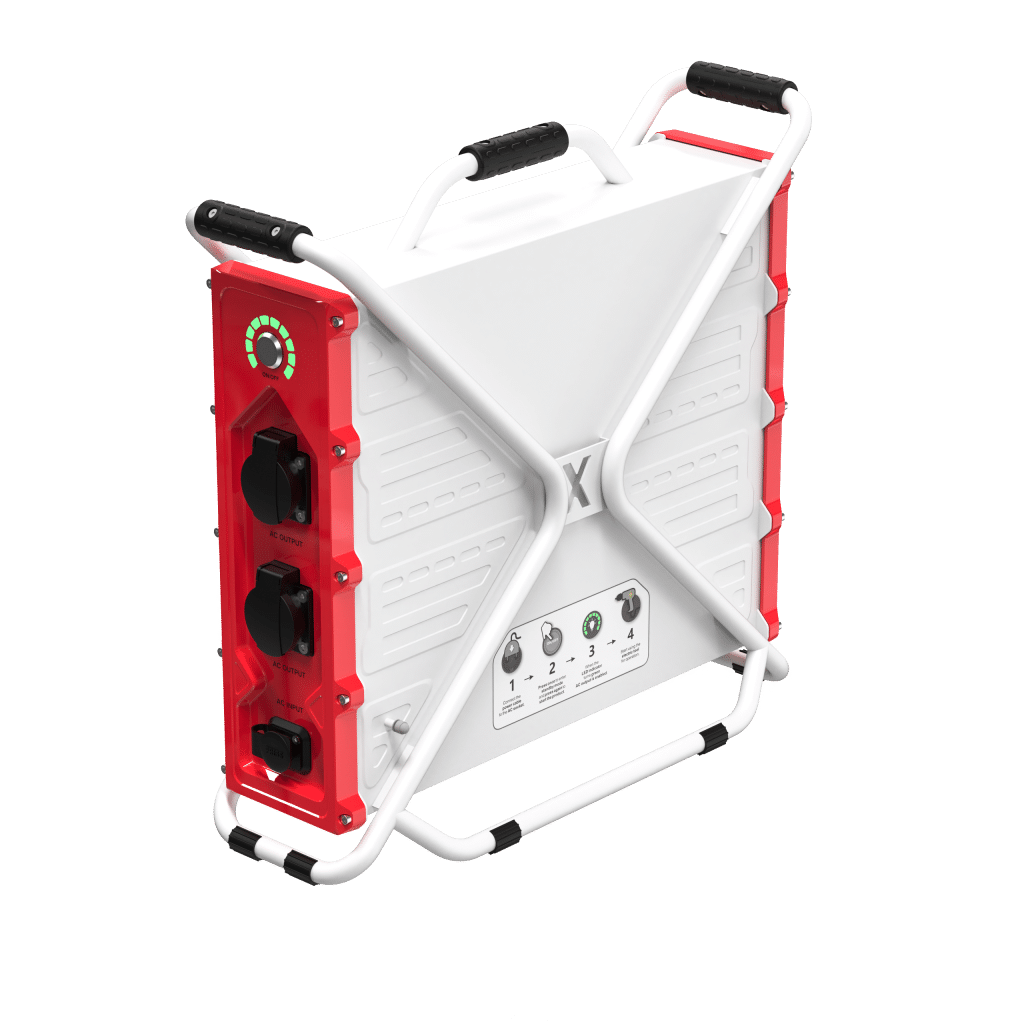
The FPG3600 industrial power station is designed around this difference between continuous and startup power.
Its main specifications include:
| Specification | FPG3600 |
|---|---|
| Rated Output | 3,600W |
| Published Peak Power | Up to 20,000W |
| Battery Capacity | 2.3kWh |
| Protection Rating | IP54 |
| Weight | 24kg |
The 3,600W rated output is intended for continuous operation.
The up to 20,000W peak output, however, is designed to support short-duration startup loads from equipment such as motors, pumps and compressors.
These two figures should not be confused: a 20,000W peak rating does not mean the FPG3600 can continuously run a 20kW machine.
What Happens When an Air Compressor Starts?
FULLAS tested the FPG3600 with a 4kW air compressor to observe its response to a high-startup load.
During compressor startup, an oscilloscope captured approximately:
209.419V × 115A ≈ 24.08kW
This was a momentary laboratory measurement, not the FPG3600’s continuous output or published peak rating. The official published peak specification remains up to 20,000W.
The test is useful because it shows how dramatically the electrical demand of motor-driven equipment can change during the first moment of startup.
A compressor labeled “4kW” does not necessarily demand only 4kW at every moment.
Which Jobsite Equipment Needs Attention to Peak Load?
Peak-load capability is particularly important when powering:
- Air compressors
- Water pumps
- Circular saws
- Miter saws
- Dust extractors
- Core drills
- Other motor-driven construction equipment
For simpler resistive or electronic loads, startup demand may be less significant.
For motors and compressors, however, checking only the rated wattage on the nameplate can lead to incorrect power-station selection.
Our guide to what construction tools a 3600W portable power station can run explains this in more detail for common jobsite equipment.
What Should You Check Before Choosing an Industrial Power Station?
Before connecting professional equipment, check four things:
1. Equipment voltage and frequency
The power station and connected equipment must use compatible electrical specifications.
2. Continuous operating power
The normal load should remain within the rated output of the power station and the limit of the selected outlet.
3. Startup or inrush current
Motor-driven equipment may require significantly more current for a short period when starting.
4. Peak-load capability
The inverter needs enough short-term overload capability to start the equipment without immediately entering protection mode.
Actual compatibility can also vary with the equipment model, startup method, battery level, wiring and operating conditions.
Peak Power and Capacity Solve Different Problems
An industrial power station needs both sufficient energy storage and sufficient inverter performance.
Capacity tells you how long you can work.
Rated output tells you what you can continuously power.
Peak output helps determine whether demanding equipment can start.
For professional jobsites, ignoring any one of these specifications can result in a system that looks powerful on paper but does not match the actual load.
The FULLAS FPG3600 industrial power station combines 3,600W rated output, 2.3kWh capacity and up to 20,000W peak power for construction, maintenance and other professional mobile-power applications.
FAQ
Is peak power the same as rated power?
No. Rated power is the continuous output the power station can supply, while peak power is available for short-duration surges such as motor startup.
Does 20,000W peak power mean the FPG3600 can run a 20kW machine?
No. The FPG3600 is rated for 3,600W continuous output. Its peak capability is intended for brief startup or high-inrush events rather than continuous 20kW operation.
Why is peak power important for an industrial power station?
Many professional tools contain electric motors that require substantially more current during startup than during normal operation. Adequate peak capability helps the power system handle these short startup demands.