









Portable Power Station for Professional Use: What B2B Buyers Should Know
A portable power station is a rechargeable battery-based power source designed to provide electricity away from fixed grid power. For professional users, however, choosing one involves more than checking battery capacity or the maximum wattage printed on a specification sheet.
Contractors, equipment distributors, maintenance teams and rental businesses need to consider continuous output, startup demand, surge duration, battery capacity, charging time, environmental protection and electrical configuration.
A unit that works well for light appliances may not necessarily start a compressor, welder or motor-driven tool. For professional applications, the key question is not simply “How many watts does it have?” but “Can it support the actual load profile of the equipment being used?”
What Is a Portable Power Station?
A portable power station stores electrical energy in an internal battery and delivers that energy through electrical outputs such as AC sockets.
Unlike a gasoline or diesel generator, it does not need to run a combustion engine while supplying battery power. This means there is no exhaust produced at the point of use during battery operation, while operating noise can also be significantly lower depending on the system. Detailed Understanding of Industrial Power Station.
For professional users, this can be useful in locations such as:
- construction and renovation sites;
- field maintenance work;
- temporary technical installations;
- film and photography locations;
- workshops and service operations;
- remote areas without convenient grid access;
- noise-sensitive working environments.
However, portable battery power should not automatically be treated as a replacement for every generator. The correct choice depends on load, runtime, charging access and working conditions.
What Makes a Portable Power Station Suitable for Professional Use?
Professional applications place different demands on a power station than charging laptops or running small household appliances.
Three specifications are especially important: continuous output, battery capacity and surge capability.

Continuous Output
Continuous output, measured in watts, tells you how much electrical load the power station is designed to support during normal operation.
For example, a power station rated at 3,600 W continuous output should not normally be treated as a 10,000 W or 20,000 W continuous power source just because it has short-duration surge capability.
Professional buyers should compare the continuous rating with the real operating requirements of the equipment they intend to use.
Battery Capacity
Battery capacity is usually expressed in watt-hours, or Wh.
Watts describe how much power a portable power station can deliver at a given moment, while watt-hours describe how much energy it stores.
These two numbers answer different questions.
A 3,600 W output rating does not mean the power station contains 3,600 Wh of energy, and a large battery capacity does not automatically mean it can operate a high-power machine.
Both values must be evaluated together.
Startup and Surge Power
Many professional loads do not draw constant power.
Motors, compressors, pumps, welders and other equipment can require significantly more power during startup or short load changes than during normal operation.
This is why professional buyers should examine more than a single “peak wattage” number.
For professional power tools, continuous wattage alone is not enough; buyers should also evaluate startup demand, surge duration and the load profile of the equipment.
Continuous Power vs Surge Power: Why the Difference Matters
Continuous and surge ratings serve different purposes.
| Specification | What It Tells the Buyer |
|---|---|
| Continuous output | Power the unit is designed to sustain during normal operation |
| Surge or peak output | Short-duration power available for temporary load increases |
| Surge duration | How long the system can support an overload |
| Battery capacity | Total stored electrical energy |
| Equipment load profile | How the connected machine actually consumes power |
For professional equipment, surge duration can be more useful than a peak-watt figure alone.
Two power stations could advertise similar peak output while behaving very differently if one can sustain an overload for only a very short period and another can support it for longer.
This distinction becomes particularly important when evaluating power for motors, compressors and welding equipment.
How Much Battery Capacity Do Professional Users Need?
There is no universal battery capacity that is suitable for every professional application.
The required capacity depends on:
- average operating load;
- operating time;
- tool duty cycle;
- conversion losses;
- frequency of equipment use;
- availability of recharging.
A simple starting point is:
Theoretical runtime = battery capacity ÷ average load
For example, a 2,304 Wh battery divided by a constant 1,000 W load gives a theoretical value of approximately 2.3 hours.
That is not a guaranteed real-world runtime.
Actual operating time can be lower because the system itself consumes energy, electrical conversion is not perfectly efficient, and many professional tools have changing rather than constant loads.
For this reason, B2B buyers should evaluate the expected daily work cycle rather than relying only on a simple Wh calculation.
Where Are Portable Power Stations Used Professionally?
Construction and Power Tools
A professional portable power station can provide temporary electricity for tools and maintenance equipment where grid access is limited or inconvenient.
Battery power can be particularly useful where operators want to reduce noise or avoid running a combustion generator close to the working area.
For deeper selection criteria, see our guide to portable power stations for construction.
Field Maintenance and Repair
Maintenance teams often work in locations where the nearest socket is not practical.
A portable battery system can support inspection, repair and service operations without requiring a permanent electrical installation.
For these users, weight, startup capability and recharge time may matter just as much as total battery capacity.
Welding
Welding is a demanding application because the electrical load can change rapidly.
A portable power station should therefore not be considered suitable for welding simply because its nominal wattage appears high enough.
Actual compatibility depends on the welding machine, settings and operating conditions.
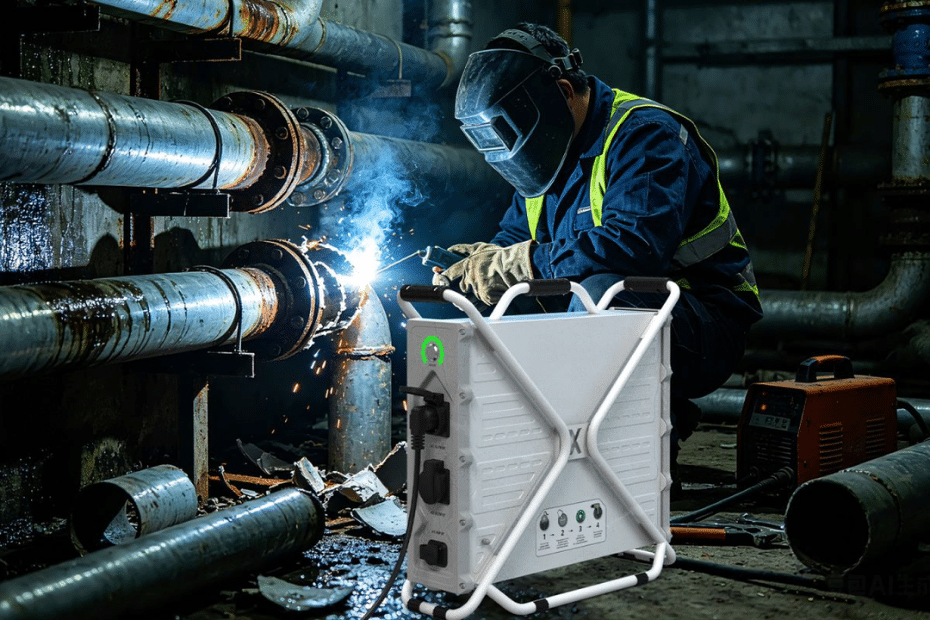
In Fullas testing, the FPG3600 powered a ZX7-315GT welding machine using 4.0 mm welding rods and reached up to 280 A under the documented test conditions.
This is application evidence rather than a universal guarantee for every welding machine. Buyers should still verify their own equipment requirements.
Film and Location Production
Film, photography and commercial-production teams frequently need temporary power for lighting, cameras and supporting equipment.
In these environments, low operating noise can be especially valuable because power equipment may be located close to the production area.
A battery-based system also avoids exhaust emissions at the point of use during battery operation.
Rental and Temporary Power
For equipment-rental businesses, portable battery power can fill the gap between small consumer power stations and larger generator-based temporary-power systems.
Rental operators should pay particular attention to:
- equipment compatibility;
- weight and transportability;
- charging turnaround;
- environmental protection;
- output configuration;
- overload behaviour;
- maintenance requirements.
Specifications B2B Buyers Should Check Before Purchasing
Professional buyers should avoid selecting a portable power station based only on capacity or maximum wattage.
The following specifications provide a more complete picture.
| Criterion | Why It Matters |
| Continuous output | Determines the sustainable operating load |
| Startup capability | Helps determine whether motors and other demanding loads can start |
| Surge duration | Shows how the unit behaves during temporary overload |
| Battery capacity | Determines the amount of stored energy available |
| AC voltage and frequency | Must match equipment and regional requirements |
| Charging time | Influences operating downtime |
| Weight and dimensions | Affect transport and daily mobility |
| IP rating | Indicates the unit’s defined environmental protection level |
| Operating temperature | Matters for outdoor and industrial use |
| RCD configuration | May be relevant to professional electrical safety requirements |
| Parallel capability | Determines whether the system can be scaled |
| Certification context | Important for transport, import and market evaluation |
Distributors and importers should also check the exact scope of certificates instead of assuming that a listed standard automatically covers every market or application.
FPG3600 as an Industrial Portable Power Station Example
The Fullas FPG3600 industrial portable power station provides a useful example of how professional specifications can be evaluated.
| Specification | FPG3600 |
| Rated output | 3,600 W |
| Battery capacity | 2,304 Wh |
| EU output | 230 V AC, 50 ±0.5 Hz |
| Dimensions | 526 × 485 × 211 mm |
| Weight | 24 kg |
| Noise | <30 dB |
| Ingress protection | IP54 |
| Cooling | Natural cooling |
| Operating temperature | -20°C to 45°C |
| Operating altitude | Up to 2,000 m |
| AC charging input | 176–264 Vac |
| Charging power | 1,200–1,300 W |
| Typical charging time | 2.3–2.5 hours |
| Parallel connection | Up to 3 units |
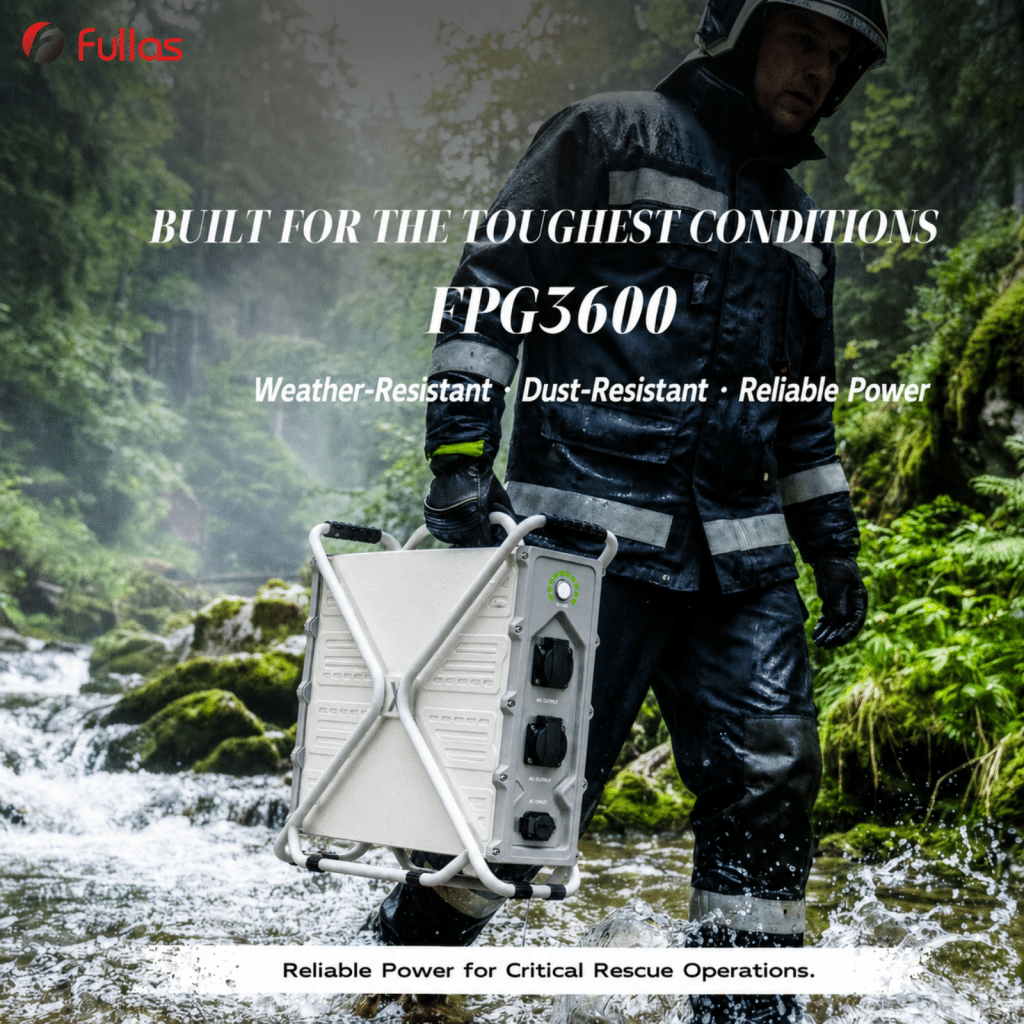
The FPG3600 is positioned for professional temporary and off-grid power rather than primarily for recreational camping use.
Its IP54 rating should not be interpreted as waterproof. It indicates a defined level of protection against limited dust ingress and water splashes in accordance with the product rating.
For professional applications where residual-current protection is required, Fullas also offers an FPG3600 RCD version with 30 mA / 30 ms RCD protection.
Why Surge Duration Matters More Than a Single Peak-Watt Number
The FPG3600 illustrates why professional buyers should examine overload behaviour rather than focusing only on an advertised peak value.
Its continuous rated output is 3,600 W.
Under specified short-duration conditions, its documented overload capability includes:
| Load Condition | Documented Duration |
| 150% load | More than 500 seconds |
| 200% load | More than 50 seconds |
| 250% load | More than 10 seconds |
| Above 9,000 W | More than 1 second |
The product documentation also specifies a peak capability of up to 20,000 W under defined short-duration conditions.
This does not mean the FPG3600 continuously outputs 20,000 W. Its continuous rated output is 3,600 W.
That distinction is important for professional buyers.
When evaluating a motor, compressor, welder or other inductive load, knowing how a power station handles temporary overload can provide more useful information than comparing peak numbers alone.
When One Portable Power Station Is Not Enough
Some professional applications require more power or stored energy than a single portable unit can provide.
In these cases, system scalability becomes an important buying criterion.
The FPG3600 supports linking up to three units.
A linked three-unit FPG3600 system provides approximately:
- 6.9 kWh total battery capacity
- 10.8 kW total rated output
A three-unit system has also been tested in a 380 V three-phase configuration.
It is important to make the distinction clear: a single FPG3600 should not be described as a 380 V three-phase power station. The documented three-phase configuration uses three linked units.
More details are available on the FPG3600 linked three-phase power station configuration.
When a Portable Power Station May Not Be the Right Choice
Battery power is useful, but it is not automatically the correct solution for every professional job.
A different power system may be more practical when:
- the load exceeds the unit’s continuous output;
- extremely long uninterrupted runtime is required;
- there is no realistic opportunity to recharge;
- permanent installed power is required;
- equipment needs a voltage, frequency or electrical configuration the power station does not provide;
- the work environment exceeds the equipment’s rated operating conditions.
Professional power selection should therefore begin with the application, not the product.
List the equipment, determine its operating and startup requirements, estimate the required runtime and then compare those requirements with the power station specifications.
Frequently Asked Questions
Can a portable power station run power tools?
Yes, a portable power station can run compatible power tools when its continuous output and temporary startup capability match the tool’s electrical requirements.
Motor-driven equipment may require considerably more power during startup than during normal operation, so buyers should check both rated power and startup demand.
What size portable power station is needed for professional work?
There is no single correct size.
Calculate the continuous load of the equipment, identify any startup or surge requirements, estimate the required operating time and then compare those figures with the power station’s output and battery capacity.
What is the difference between watts and watt-hours?
Watts measure power output, while watt-hours measure stored energy.
A 3,600 W power station rating indicates how much load it can support, while a 2,304 Wh battery rating indicates how much electrical energy is stored.
Can a portable power station run a welder?
Some portable power stations can operate compatible welding equipment, but suitability depends on the welder, settings and load behaviour.
In Fullas testing, an FPG3600 operated a ZX7-315GT welder with 4.0 mm rods and reached up to 280 A under the documented test conditions.
This test should not be treated as a guarantee for every welding machine.
Is a portable power station better than a gasoline generator for professional work?
Neither option is universally better.
Portable battery systems can be attractive where low noise, mobility and no exhaust emissions at the point of use are important. Fuel generators may remain more practical for some very long-duration or continuously high-load applications.
The correct choice depends on the load, runtime, work environment and access to fuel or charging.
Can a portable power station provide three-phase power?
Most individual portable power stations should not automatically be assumed to provide three-phase output.
Some specifically designed systems can create a three-phase configuration by linking multiple units. For example, Fullas has tested three linked FPG3600 units in a 380 V three-phase configuration.
Final Takeaway
Choosing a professional portable power station requires more than comparing battery size or advertised peak wattage.
B2B buyers should evaluate continuous output, battery capacity, startup demand, surge duration, charging time, environmental protection, electrical configuration and scalability against the actual equipment they intend to operate.
For demanding professional loads, surge behaviour is especially important. A clear understanding of how much power is available, for how long, and under what conditions gives buyers a much more useful basis for comparison than a single maximum-watt figure.
Fullas positions the FPG3600 as a professional portable battery power system for temporary and off-grid applications, with 3,600 W rated output, 2,304 Wh capacity, documented short-duration overload capability and support for linked multi-unit configurations.
For more professional battery-power options, explore the Fullas industrial power station range.