









How to Choose an OEM Inverter Generator Manufacturer in China
Choosing an OEM Inverter Generator manufacturer in China is not only about comparing prices. For importers, distributors, and equipment brands, the real question is whether the supplier can deliver stable quality, correct certificates, export-ready documents, and long-term OEM support. A low price may look attractive at the beginning, but if the generator cannot pass local compliance requirements, has unstable power output, or lacks after-sales parts support, the real cost can become much higher.
China has a mature supply chain for gasoline engines, generators, inverter generators, and outdoor power equipment. However, not every supplier is suitable for OEM cooperation. Some companies are trading companies with limited technical control, some factories only produce standard models, and some suppliers may not understand the compliance requirements of your target market. Therefore, before choosing an OEM partner, buyers should evaluate the manufacturer from the perspectives of legal export qualification, product compliance, factory capability, testing process, customization ability, and long-term service.


1. Check Whether the Manufacturer Has Legal Export and Business Qualifications
Before talking about price, buyers should first confirm whether the Chinese supplier is a legally registered company and whether it has real export capability. A reliable OEM manufacturer should be able to provide basic company information, business license, export experience, product catalogue, factory address, and contact details that are consistent across documents and online channels.
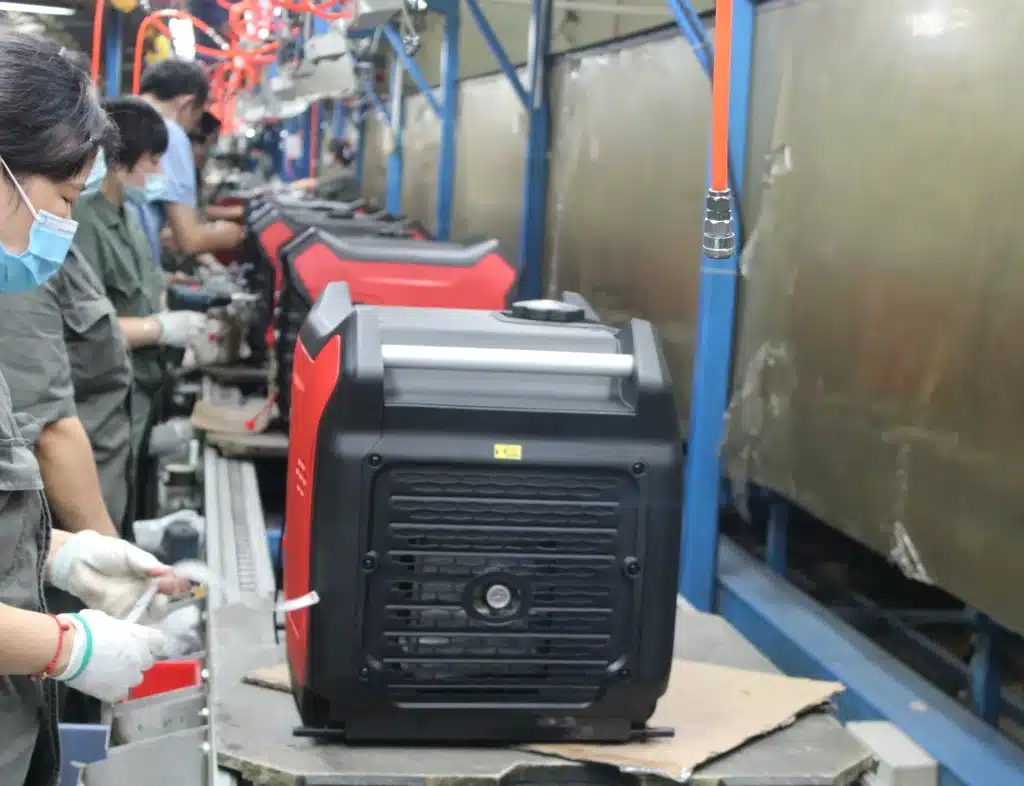
For generator products, the supplier should understand export declaration, commercial invoice, packing list, bill of lading, certificate of origin if required, and the destination country’s customs requirements. If the supplier cannot clearly explain how the goods will be exported, which documents are normally prepared, or what information is needed for customs clearance, the buyer should be careful.
For buyers importing into the United States, the engine compliance issue is especially important. The U.S. Environmental Protection Agency states that imported nonroad engines and equipment, including generators, must conform to EPA emission standards and requirements. This means that buyers should not only check the generator appearance or power rating, but also confirm whether the engine used in the generator is suitable for the target market.
For buyers importing into the European market, CE-related compliance, emissions, noise, and safety requirements should also be checked carefully. A serious OEM manufacturer should be willing to discuss certificates and test reports before order confirmation, instead of only saying “we can do it” without supporting documents.
2. Confirm the Required Certifications for Your Target Market
A common mistake in sourcing OEM inverter generators is asking only: “Do you have CE?” or “Do you have EPA?” This is not enough. Different countries and markets may require different documents. A good supplier should help you match the product configuration with the destination market.
For example, an OEM Inverter Generator for the U.S. market may need EPA-related compliance for the gasoline engine. For the EU market, buyers usually pay attention to CE, EMC, noise, and emission-related requirements. For some markets, buyers may also need local import certificates, customs documents, or distributor-specific labeling.
China also has its own product certification system. For example, China Compulsory Certification, known as CCC, is China’s national safety and quality mark for products listed in the CCC catalogue. Buyers do not need to assume that every exported generator must have CCC, but they should understand that Chinese manufacturers operate within a product standard and certification environment, and serious suppliers usually know the difference between domestic market certification and export market certification.
When checking certificates, do not only ask for a PDF file. You should also check whether the certificate holder matches the supplier or its production partner, whether the model number matches the product you are buying, whether the certificate is still valid, whether the test standard is suitable for your market, and whether the report covers the engine, generator, inverter module, noise, and electrical safety where applicable.
A practical checklist can include:
- Company name on certificate
- Product model covered by certificate
- Engine model and displacement
- Rated voltage and frequency
- Emission standard
- Test report issue date
- Validity period
- Testing laboratory information
- Whether OEM branding is allowed under that certificate
This step is very important because some suppliers use certificates from similar models, old versions, or unrelated products. For B2B importers, this can create customs risks and market access problems.
3. Evaluate Whether the Factory Really Understands OEM Work
OEM is not just printing your logo on the generator shell. A real OEM cooperation may involve appearance color, brand label, control panel layout, packaging design, manual language, plug type, voltage configuration, frequency, carton marks, spare parts list, and sometimes even product structure adjustments.
When choosing an OEM Inverter Generator manufacturer in China, buyers should ask what can be customized and what cannot be changed. A professional factory will usually explain customization levels clearly. For example, simple customization may include logo, color, carton, and manual. Deeper customization may include panel design, socket configuration, product label, warning sticker, and packaging structure.
For inverter generators, the control panel is a key area. Different markets may need different sockets, voltage, frequency, USB ports, DC output, parallel connection ports, Bluetooth function, ECO mode, or electric start. If the supplier has no experience in these details, the OEM project may face many communication problems after the order starts.
A good OEM supplier should be able to provide:
- Logo and color customization
- Private label packaging
- Product manual customization
- Voltage and socket options
- Carton and shipping mark design
- Product label and warning sticker support
- Spare parts and after-sales support
- Stable model continuity for future repeat orders
OEM cooperation is usually long-term. The supplier should not only complete one order, but also help the buyer build a stable product line.
4. Compare Product Specifications, Not Only Product Photos
Many inverter generators look similar from the outside, but their internal configuration and performance can be very different. Buyers should compare technical data carefully.
Important specifications include engine model, displacement, fuel tank capacity, rated power, starting power, running time, rated voltage, frequency, THD, noise level, net weight, product dimensions, packing dimensions, and loading quantity.
For example, FULLAS inverter generator models cover different power ranges for different markets and applications. Smaller models such as FP2300i and FP2300iS are suitable for portable use, outdoor work, light commercial use, and distributors targeting compact power products. Mid-range models such as FP3300i, FP4500i, FP4800iS, and FP7000iS can meet stronger jobsite and commercial power needs. Larger models such as FP10000iS and FP12500iS are more suitable for customers who need higher output and stronger backup power capacity.
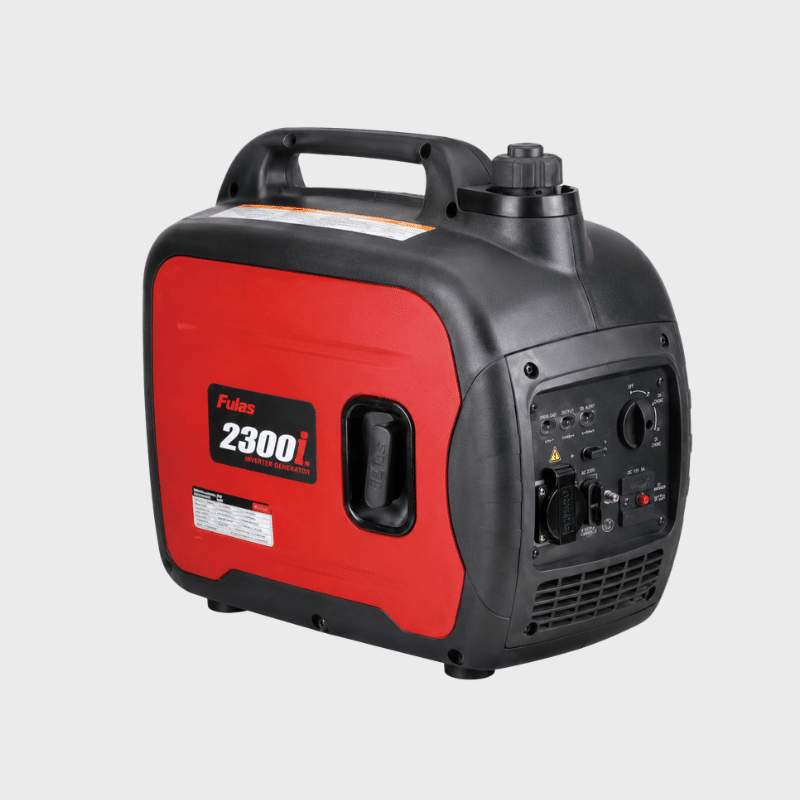

FP2500i Inverter Generator
2.1 kW Running Power, FP152F-2 Engine, Compact Inverter Generator With Stable Clean Power Output.


FP7500i Inverter Generator
6.5 kW Running Power, FP190FD-2 Engine, High-Power Portable Inverter Generator for Commercial and Backup Use.
When reviewing specifications, buyers should pay attention to the difference between running power and starting power. Running power means the generator can continuously support that load. Starting power is the short-time peak power used when starting tools or equipment with high inrush current. For professional users, this difference is very important.
THD is another important factor. Lower THD means cleaner power output, which is better for sensitive electronics and stable equipment operation. Inverter generators are often chosen because they provide more stable power than traditional generators, especially for tools, chargers, electronic devices, and professional work scenarios.
5. Check Noise Level and Real Application Scenarios
One of the main reasons buyers choose inverter generators is low noise. However, noise data should be checked carefully. Suppliers may use different testing distances or different load conditions. When comparing noise, ask whether the data is tested at 1/4 load, 1/2 load, or rated load, and ask for the test condition if possible.
For distributors, noise level is not only a technical parameter. It affects customer satisfaction. Inverter generators are often used in camping, RV, outdoor markets, small business backup, construction sites, mobile repair, and event power supply. If the generator is too noisy, it may not be suitable for certain applications.
A good OEM manufacturer should be able to explain why the product is quieter. For example, it may use better sound-absorbing materials, optimized air duct design, lighter moving parts to reduce vibration, or improved muffler structure. If a supplier only says “very quiet” but cannot explain the structure or provide data, the buyer should ask more questions.
6. Review the Factory Testing Process Before Shipment
For an OEM Inverter Generator, stable quality depends heavily on testing. Buyers should ask the factory how each generator is tested before shipment.
A reliable manufacturer usually has inspection steps such as appearance inspection, assembly check, engine start test, voltage and frequency test, load test, noise check, safety inspection, oil leakage check, packaging inspection, and random final inspection before loading.
For inverter generators, the inverter module and output stability are especially important. The supplier should check whether the generator starts smoothly, whether output voltage is stable, whether frequency remains within the expected range, whether the ECO mode works properly, and whether overload protection functions correctly.
Before placing a bulk order, buyers can request:
- Pre-production sample
- Test video
- Internal inspection report
- Product photos before packing
- Carton photos
- Loading photos
- Third-party inspection if needed
This is not about making the supplier uncomfortable. It is normal B2B risk control. A serious supplier will understand this.
7. Check MOQ, Lead Time, and Production Stability
MOQ is another important factor when choosing an OEM generator supplier. For standard models, some suppliers may accept a lower MOQ. For customized color, private label, customized carton, or special socket configuration, MOQ may be higher because the factory needs to prepare materials separately.
Buyers should ask clearly:
- MOQ for standard model
- MOQ for logo customization
- MOQ for color customization
- MOQ for customized carton
- Sample lead time
- Bulk order lead time
- Peak season production capacity
- Spare parts availability
Do not only ask “what is your best price?” A better question is: “What is the most stable configuration for my target market, and what MOQ is required for OEM branding?” This helps the supplier recommend a realistic solution.
A good OEM supplier should have stable production capacity and repeat-order support. If the supplier changes parts frequently without notice, the buyer’s brand quality may become unstable.
8. Pay Attention to Packaging and Loading Quantity
Packaging is often ignored, but it directly affects shipping cost and product damage rate. For inverter generators, buyers should check carton size, packing dimension, foam protection, wooden box option if needed, loading quantity for 20GP and 40HQ, and whether the packaging is suitable for long-distance sea freight.
For B2B distributors, loading quantity affects the final landed cost. Two products with similar FOB price may have different shipping costs because of size and packing design. Therefore, when comparing suppliers, buyers should compare the complete cost, not only the unit price.
A professional manufacturer should provide product dimension, packing dimension, net weight, gross weight, and container loading quantity. This helps importers calculate logistics cost more accurately.
9. Ask About Spare Parts and After-Sales Support
A generator is not a one-time product. End users may need air filters, spark plugs, recoil starters, wheels, panels, mufflers, fuel caps, inverter modules, and other spare parts. If the supplier cannot provide spare parts support, the buyer’s local brand reputation may suffer.
Before choosing an OEM supplier, ask whether spare parts are available, whether parts list can be provided, whether parts can be packed with bulk orders, and whether the supplier can support technical questions after delivery.
For distributors, after-sales support is one of the biggest differences between a short-term supplier and a long-term OEM partner.
10. Choose a Supplier with a Clear Product Line
A good OEM manufacturer should not only offer one model. It should have a clear product range so that buyers can build a complete product portfolio.
For example, a distributor may need compact inverter generators for outdoor and RV markets, mid-power inverter generators for contractors and commercial users, and high-power silent inverter generators for backup power and professional applications. If the supplier can offer multiple models under the same brand style, the buyer can build a more complete local product line.
FULLAS provides inverter generator options covering compact, mid-range, and higher-power models, including models such as FP2300i, FP3300i, FP4500i, FP2300iS, FP4800iS, FP7000iS, FP10000iS, and FP12500iS. These models are designed for different power needs, from portable outdoor use to stronger commercial backup applications. Buyers who are looking for an OEM Inverter Generator solution can view the product range here:
Why Consider FULLAS for OEM Inverter Generators?
FULLAS focuses on power equipment supply for global B2B markets, including engines, generators, inverter generators, lawn mowers, industrial power stations, high pressure washers, and related equipment. For inverter generators, FULLAS can support buyers with model selection, specification comparison, OEM branding, packaging discussion, and export-oriented communication.
For buyers who want to develop their own generator brand, FULLAS can help evaluate which model is more suitable based on power range, target market, application scenario, budget, and certification needs. Instead of only recommending the highest-power model, a practical OEM supplier should help the buyer choose a product that can sell well in the local market.
FULLAS inverter generators are suitable for distributors, wholesalers, equipment brands, rental markets, outdoor power suppliers, and commercial users who need quiet, portable, and stable power solutions. Depending on the model, the product line can support features such as low noise operation, ECO mode, parallel function, DC and USB interfaces, recoil start, electric start, and different power outputs.
Final Checklist Before Choosing an OEM Inverter Generator Manufacturer
Before confirming an order, buyers can use this checklist:
- Is the supplier legally registered and export-experienced?
- Can the supplier provide real product specifications?
- Are certificates suitable for your target market?
- Does the engine meet local emission requirements?
- Can the supplier explain OEM customization options clearly?
- Are voltage, frequency, socket, label, and packaging details confirmed?
- Is the testing process clear before shipment?
- Are spare parts available?
- Is the MOQ reasonable for your business stage?
- Can the supplier support repeat orders with stable configuration?
- Does the supplier understand B2B export communication?
Choosing an OEM Inverter Generator manufacturer in China should be a practical decision based on compliance, quality, factory capability, and long-term cooperation. A reliable supplier should not only offer a competitive price, but also help buyers reduce import risks, build a stable product line, and support local market growth.