









What Is an Eco Friendly Generator? Battery Power as an Alternative to Fuel Generators
An eco friendly generator is generally understood as a power source designed to reduce some of the environmental and operational drawbacks associated with conventional fuel generators.
For professional users, this usually means looking beyond a “green” label. Important factors include exhaust emissions at the point of use, operating noise, fuel consumption, maintenance requirements and how efficiently the power source matches the actual load.
Battery power stations are one alternative. They do not run a combustion engine while supplying power, which means no exhaust emissions at the point of use during battery operation and significantly lower operating noise.
However, battery power should not automatically be described as having zero environmental impact. Battery production and the electricity used for charging also matter.

What Makes a Generator More Eco Friendly?
For contractors and professional users, an eco friendly generator can be evaluated using a few practical questions:
| Factor | Why It Matters |
|---|---|
| Exhaust at point of use | Combustion generators produce exhaust while operating |
| Noise | Engine noise can affect workers and nearby areas |
| Fuel use | Fuel requires transport, storage and refilling |
| Efficiency | Oversized generators may run inefficiently at light loads |
| Maintenance | Combustion engines require oils, filters and other servicing |
| Power matching | The system should match the real equipment load |
A battery power station changes several of these factors because electricity is stored before use rather than produced continuously by an engine.
The U.S. EPA specifically warns that portable fuel-generator exhaust contains carbon monoxide and that such generators should never be operated inside homes, garages or similar enclosed areas.
EPA guidance on carbon monoxide and portable generators
Battery Power Station vs Fuel Generator
The environmental difference is easiest to understand at the point of use.
| Battery Power Station | Fuel Generator | |
|---|---|---|
| Combustion engine | No | Yes |
| Exhaust during operation | No exhaust at point of use | Combustion exhaust |
| Operating noise | Generally low | Engine and exhaust noise |
| On-site fuel | Not required during battery operation | Required |
| Runtime | Limited by stored energy | Can continue with additional fuel |
| Recharging/refueling | Recharge required | Refueling required |
This does not mean battery power is automatically better for every application.
Fuel generators can still be practical for very long continuous operation where charging access is limited. Battery systems become particularly useful when mobility, low noise and avoiding combustion exhaust close to the work area are priorities.
For a deeper technical comparison, see Fullas’ portable power station vs gas generator guide. Portable Power Station vs Gas Generator for Professional Use
FPG3600 as a Professional Battery Power Example
The Fullas FPG3600 industrial portable power station is designed for professional temporary and off-grid power applications.
Its key specifications include:
| Specification | FPG3600 |
|---|---|
| Rated output | 3,600 W |
| Battery capacity | 2,304 Wh |
| EU output | 230 V AC / 50 Hz |
| Noise | <30 dB |
| Protection | IP54 |
| Weight | 24 kg |
| Charging time | Approx. 2.3–2.5 hours |
| Cooling | Natural cooling |
It also provides documented short-duration overload capability for tools and equipment with higher startup demand. The continuous rating remains 3,600 W; higher peak figures should not be interpreted as continuous output.
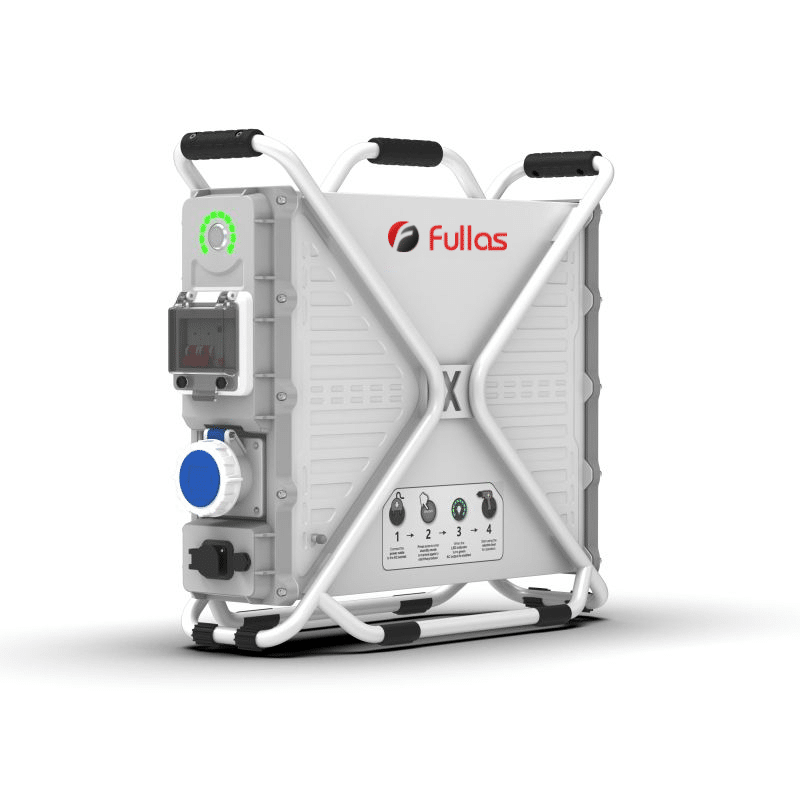

View the FPG3600 Industrial Power Station
For professional work, the environmental benefit is straightforward:
The FPG3600 produces no combustion exhaust at the point of use during battery operation and operates below 30 dB under specified conditions.
That can make a meaningful difference in applications where a conventional engine would otherwise operate close to workers, customers or recording equipment.
Where Does Battery Power Make the Most Sense?
Construction and Renovation
Construction does not always require a generator running continuously all day.
For drilling, cutting, maintenance and other intermittent work, portable battery power can bring electricity closer to the tool while reducing engine noise and fuel handling around the working area.
For more demanding jobsite planning, see the Fullas construction site power supply guide. Construction Site Power Supply Guide
Maintenance and Field Service
Technicians frequently need temporary power for tools, diagnostic equipment and repairs away from grid electricity.
In these situations, mobility can matter as much as battery capacity. A compact battery system eliminates the need to transport fuel for every short service task.
Film and Location Production
Film production is a strong example because generator noise can directly interfere with the work.
During a commercial shoot on New Zealand’s coastline, the production crew deployed an FPG3600 close to cameras and other equipment. The unit provided mobile power while operating at less than 30 dB and without engine exhaust at the filming location.
Read the New Zealand film production case
Is Battery Power Really Zero Emission?
At the point of use, a battery power station does not produce combustion exhaust while discharging.
That is different from saying the entire system has zero lifecycle emissions.
The overall environmental impact also depends on factors such as:
- how the electricity used for charging was generated;
- battery manufacturing;
- product service life;
- transportation;
- end-of-life treatment.
For professional buyers, a more accurate description is therefore:
No exhaust emissions at the point of use during battery operation.
This is clearer than making an unrestricted “zero-emission” claim.
How Should Professional Buyers Choose?
An environmentally preferable power source still has to do the job.
Before choosing an eco friendly generator alternative, check:
- continuous power requirement;
- startup and surge demand;
- required runtime;
- charging availability;
- voltage and frequency;
- operating noise;
- environmental protection;
- portability.
For power tools in particular, Fullas’ mobile generator for power tools guide explains how rated output and startup demand should be matched. Mobile Generator for Power Tools and Jobsite Equipment
FAQ
What is an eco friendly generator?
An eco friendly generator generally refers to a power source designed to reduce fuel use, local exhaust, noise or other environmental impacts compared with conventional combustion generators.
Is a battery power station an eco friendly generator alternative?
It can be. A battery power station produces no combustion exhaust at the point of use during battery operation and generally operates much more quietly than an engine-driven generator.
Is a battery power station completely emission-free?
Not across its entire lifecycle. Battery manufacturing and electricity generation also have environmental impacts. The accurate claim is that there are no exhaust emissions at the point of use during battery operation.
Can battery power be used on construction sites?
Yes, when the continuous output, startup capability and runtime match the tools being used. For long-duration heavy loads, another power solution may still be more practical.
Conclusion
An eco friendly generator should not be judged by a marketing label alone.
For professional users, the practical questions are whether the power source can reduce on-site exhaust, noise and fuel logistics while still providing the output required by the equipment.
Battery power stations such as the FPG3600 provide one option for construction, maintenance and film-production applications where those factors matter. With 3,600 W rated output, 2,304 Wh capacity, IP54 protection and <30 dB operating noise, the FPG3600 combines professional power capability with a battery-based alternative to small combustion generators.