









How Long Does a Portable Power Station Last for Construction Sites?
On construction sites, power is never just about wattage. It is about whether your equipment can keep working through a full shift, whether the unit is quiet enough for sensitive environments, and whether it is practical to move from one work zone to another. That is why more contractors, rental companies, and project managers are now asking the same question: how long does a portable power station last for construction sites?
The practical answer is this: a portable power station can last anywhere from 1 to 20+ hours on a construction site, depending on the battery capacity, output level, the type of tools connected, and whether those tools run continuously or intermittently. For light-duty site power such as charging batteries, running lights, laptops, monitors, or small electric tools, a high-capacity portable power station can often cover a large part of the workday. For high-draw tools running nonstop, runtime will be much shorter.
That is why buyers should never ask only “how many watts?” They should also ask “how long under real jobsite use?”
What determines how long a portable power station lasts?
The runtime of a portable power station on a construction site depends on four main factors.
1. Battery capacity
Battery capacity is usually measured in watt-hours (Wh). This tells you how much stored energy the unit has. In simple terms, the larger the battery capacity, the longer the runtime.
A unit with 2000Wh+ capacity is far more suitable for construction sites than a small consumer camping model, because jobsite equipment usually has higher startup loads and more demanding daily use.

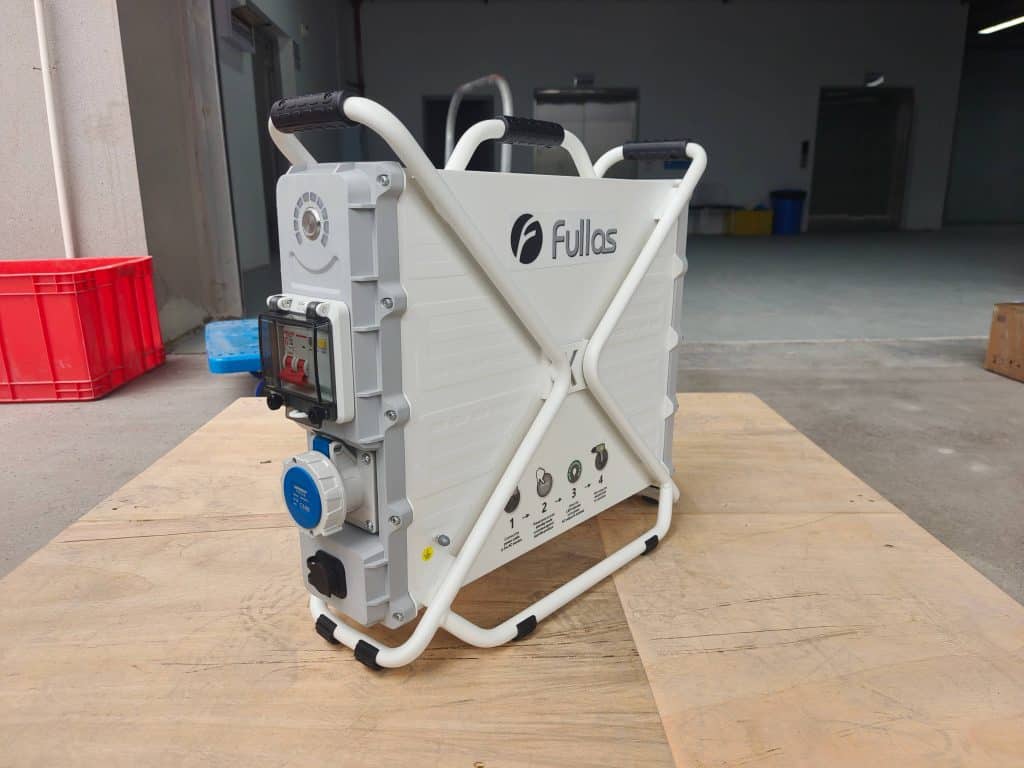
You can also look at a practical example to better understand how battery capacity affects real jobsite performance. For instance, an industrial-grade portable power station like our FPG3600 features a 2.3kWh battery capacity, and it supports parallel connection of up to three units, expanding the total capacity to 6.9kWh when needed. In terms of durability, it is rated for around 800 charge cycles (approximately 1,600 hours of use), while in real-world conditions—especially when operated within an optimal 20% to 80% charge range—the lifespan can extend significantly, reaching up to 2,500 hours. Even after 800 cycles, the battery is designed to retain at least 80% of its original capacity, which is critical for maintaining stable output on demanding construction sites.
The U.S. Department of Energy explains battery storage in simple terms: batteries store and release electricity on demand, which is the basis for how portable power stations operate in real applications. You can reference the DOE’s battery overview here: DOE Explains Batteries.
2. The actual power draw of your tools
A portable power station does not “last” in isolation. It lasts based on what you connect to it.
A few examples:
- LED jobsite lighting: low power draw, long runtime
- Laptop, router, monitoring devices: low to medium power draw
- Battery charger for cordless tools: medium power draw
- Hammer drill, angle grinder, circular saw: higher power draw
- Large heating tools or heavy continuous loads: much shorter runtime
This is why the same power station may last nearly a full shift in one scenario, but only a couple of hours in another.
3. Continuous use vs intermittent use
Construction tools rarely run at 100% nonstop for an entire day. In many cases, workers use tools in cycles: cut, stop, measure, move, adjust, repeat. That makes real-world runtime different from the “lab calculation.”
For example, if a grinder is rated at 1000W, that does not mean it will necessarily drain the battery as if it runs continuously for eight hours. In actual site use, the on-and-off working pattern often stretches usable runtime far beyond a simple constant-load estimate.
4. Power conversion efficiency and site conditions
No power system is 100% lossless. Some energy is lost during conversion and output. Temperature, dust, charging habits, and heavy surge loads can also affect usable runtime.
On rough construction sites, buyers should care not only about capacity, but also about durability, stable output, and whether the system is designed for industrial use rather than occasional leisure use.
A simple way to estimate portable power station runtime
A practical runtime formula is:
Runtime = Battery capacity (Wh) × efficiency ÷ device power (W)
If you assume around 85% to 90% usable efficiency, you can get a more realistic estimate.
For example, if a portable power station has 2304Wh capacity and your tool or load uses 500W continuously:
2304 × 0.85 ÷ 500 = about 3.9 hours
If the same load is only used intermittently, the practical working time on site may be much longer.
Here are a few simple examples for a high-capacity portable power station used on construction sites:
- 100W site lighting or electronics: around 19 hours
- 300W charging and light-duty operation: around 6.5 hours
- 500W continuous load: around 4 hours
- 1000W continuous load: around 2 hours
These numbers are not “promises” for every site, but they give buyers a realistic framework for planning.
Is a portable power station enough for a full construction shift?
In many jobsite scenarios, yes. In others, it depends on what you are powering.
A portable power station is often a very good fit for:
- battery charging stations for cordless tools
- temporary lighting
- inspection equipment
- laptops and field communication devices
- testing instruments
- indoor or enclosed-area work where low noise matters
- quick mobile power support in areas without fixed electricity
It may be less suitable as the only power source for:
- multiple heavy corded tools running continuously
- all-day high-load equipment with constant demand
- very large site operations requiring nonstop high output across many devices
In those cases, contractors often use portable power stations either as a quieter supplementary power source or for specific work zones rather than as a full generator replacement.
Why runtime matters even more on construction sites
On a jobsite, runtime affects much more than convenience. It affects workflow, labor efficiency, and even safety.
Traditional fuel-powered equipment still has its place, but there are many environments where quieter and cleaner temporary power has clear advantages. OSHA has repeatedly highlighted the hazards of carbon monoxide exposure from portable generators and other fuel-powered equipment, especially in enclosed or partially enclosed work areas. That is one reason battery-based site power solutions are getting more attention in indoor, underground, renovation, utility, and temporary-access projects. A useful OSHA reference is here: Using Portable Generators Safely.
For contractors, this shifts the conversation from “Can it run?” to “Can it run safely, quietly, and efficiently where I actually need it?”
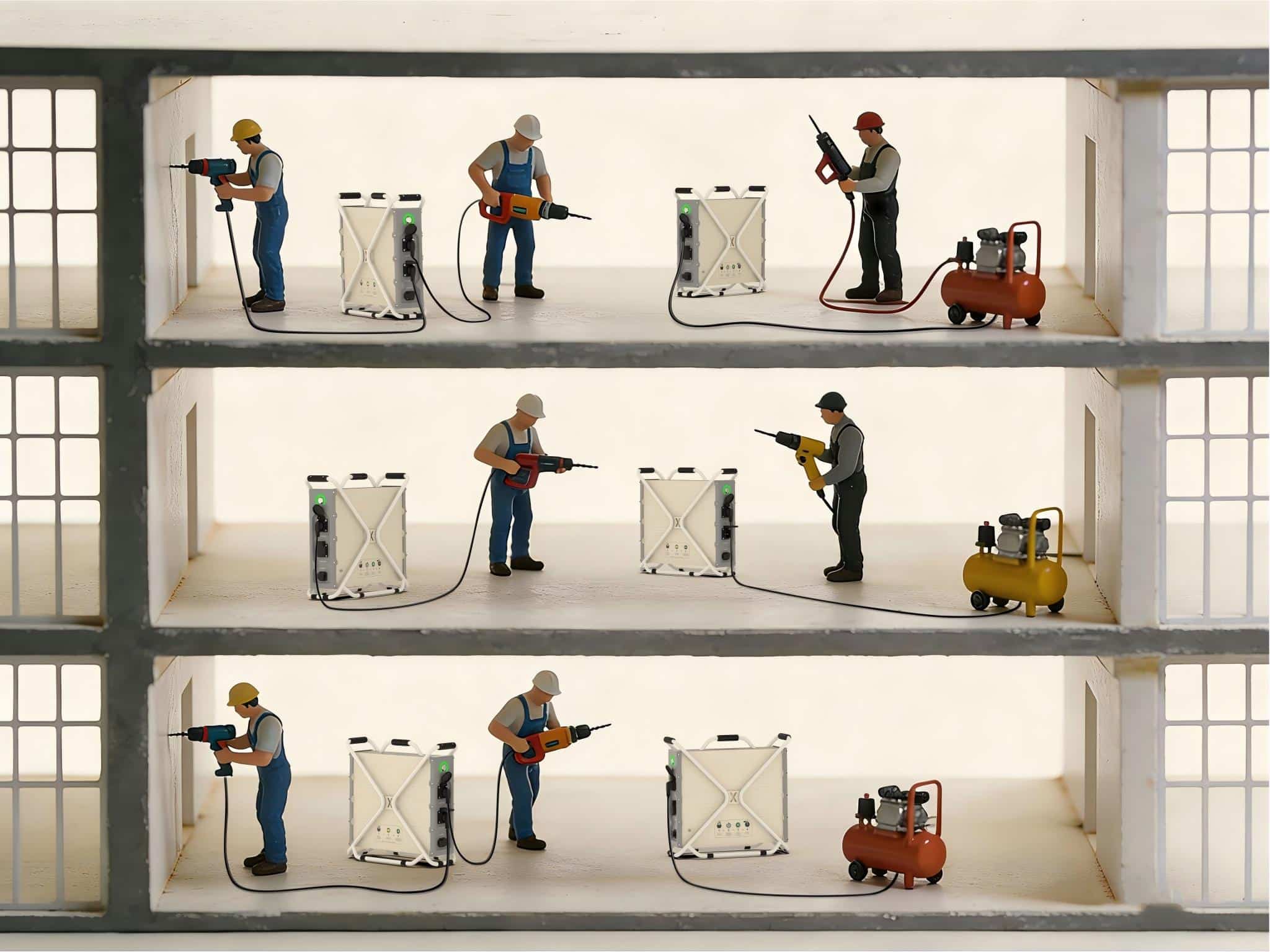
What our customers care about most(Including real usage pictures from customers)
When customers ask how long a portable power station lasts for construction sites, they are usually not asking for a textbook answer. They are asking whether it will hold up in real work.
From our communication with buyers and professional users, the most common concerns are:
- Will it cover the key hours of the work shift?
- Can it handle startup power from tools?
- Is it quiet enough for indoor or low-noise projects?
- Is it easy to move between floors, rooms, or outdoor points?
- Can it reduce reliance on fuel equipment in certain zones?
Some customers summarized it very directly:
- “It gave us enough power for charging tool batteries and running temporary lighting without the noise of a generator.”
- “For indoor fit-out work, it was much easier to use than moving a fuel generator in and out.”
- “We didn’t use it for every heavy tool all day, but for mobile jobsite power it made the workflow much smoother.”

Another customer concern we often hear is not only about runtime, but about workflow. They do not want a unit that looks good on paper but becomes inconvenient in actual site movement, charging schedules, or temporary task switching. In other words, buyers want runtime that matches how construction teams really work, not just a theoretical number.
A more realistic buying standard for construction use
If you are sourcing a Portable Power Station for construction sites, do not judge it by one number alone. Look at the combination of:
- battery capacity
- rated output
- peak power capability
- charging speed
- protection level
- portability
- noise level
- whether it is positioned for industrial or jobsite use
A compact consumer unit may be fine for camping, but construction use usually requires stronger output, tougher protection, and more reliable all-day performance.
That is also why many professional buyers are now looking for portable power stations built specifically for harsher jobsite conditions instead of general-use lifestyle products.
A practical option for jobsite power
If you are looking for a more construction-oriented solution, you can take a look at our Portable Power Station FPG3600.
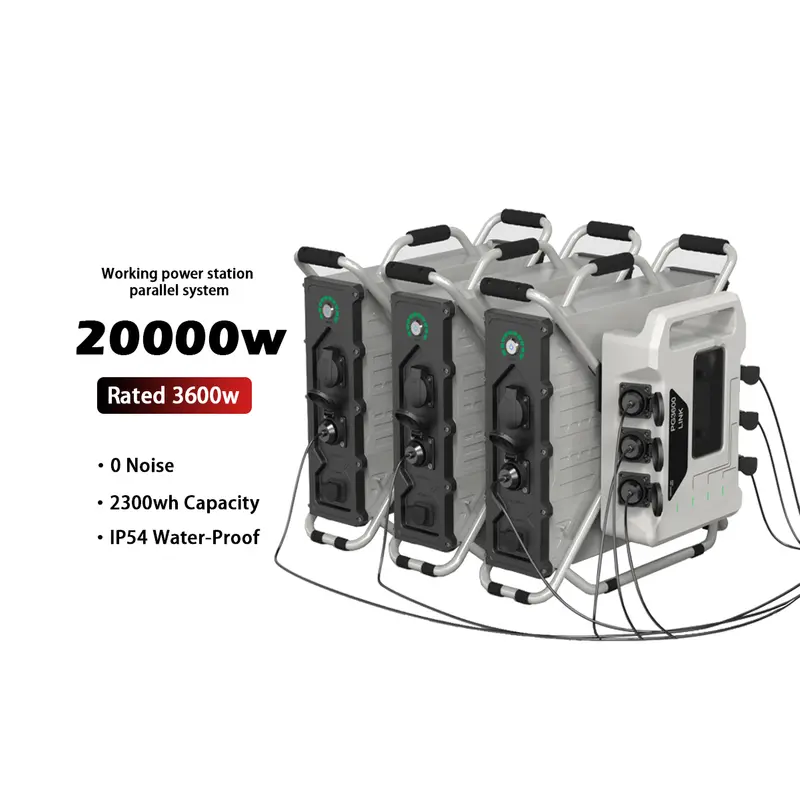

It is designed with professional jobsite and industrial use in mind, rather than light recreational use. For buyers comparing different temporary power options, this matters because runtime is only part of the decision. Stable output, mobility, fast recharge, and suitability for real work environments matter just as much.
For example, if your project needs temporary power for charging cordless tool batteries, lighting enclosed work areas, supporting inspection devices, or covering short-term power demand where low noise is important, a higher-capacity industrial portable power station is often a smarter fit than a small consumer model.
Final answer: how long does a portable power station last for construction sites?
A portable power station can last from a few hours to most of a workday on a construction site, depending on the battery size and the type of equipment being powered. For light-to-medium site loads, a high-capacity unit can often support several hours of practical operation and, in some applications, much longer. For heavy continuous loads, runtime will be shorter, so proper load planning is essential.
The best way to choose the right model is to match the unit to your real tools, not to a generic marketing claim. On construction sites, runtime is not just about battery size. It is about whether the power solution fits the way your team actually works.
FAQ
Can a portable power station run power tools on a construction site?
Yes, but runtime depends on the wattage and whether the tools run continuously or intermittently. Cordless tool battery charging, lighting, and moderate power tools are often a very good fit.
Is a portable power station better than a generator for indoor construction work?
In many indoor or low-ventilation situations, a portable power station can be a more practical option because it avoids fuel exhaust at the point of use. OSHA warns about carbon monoxide hazards from portable generators in enclosed spaces.
How do I calculate runtime for my site equipment?
Use this formula: battery capacity (Wh) × efficiency ÷ device wattage (W). For real jobsite planning, it is better to assume around 85% usable energy rather than 100%.