









Portable Power for Filmmaking on Location Complete Guide for Professionals
Portable Power for Filmmaking on Location: Complete Guide for Professionals
Filmmaking on location is exciting, but power is often one of the first problems a crew runs into. Once you move away from a studio or a venue with fixed electrical access, every piece of gear depends on how well your mobile power setup is planned. Cameras, LED lights, field monitors, wireless video systems, laptops, battery chargers, audio recorders, and support equipment all need stable power. That is why Portable Power for Filmmaking on Location has become an important topic for production teams, rental companies, documentary crews, and commercial shooters.
Many crews used to rely mainly on fuel generators. They still work in some outdoor scenarios, but they also bring noise, exhaust, setup limitations, and more safety concerns. Official guidance from CDC and OSHA warns that portable generators produce carbon monoxide and should never be used indoors or near openings where exhaust can enter occupied spaces. That matters on film sets, especially when shooting in enclosed, semi-enclosed, or sensitive environments.
This is why more professionals are now looking at battery-based portable power systems for location work. A good portable power station can offer quieter operation, no direct exhaust emissions at the point of use, easier transport, and stable output for sensitive filming equipment. For crews that need a cleaner and less disruptive workflow, the right battery power solution can improve both efficiency and the shooting environment.
Why Portable Power Matters on Location Shoots
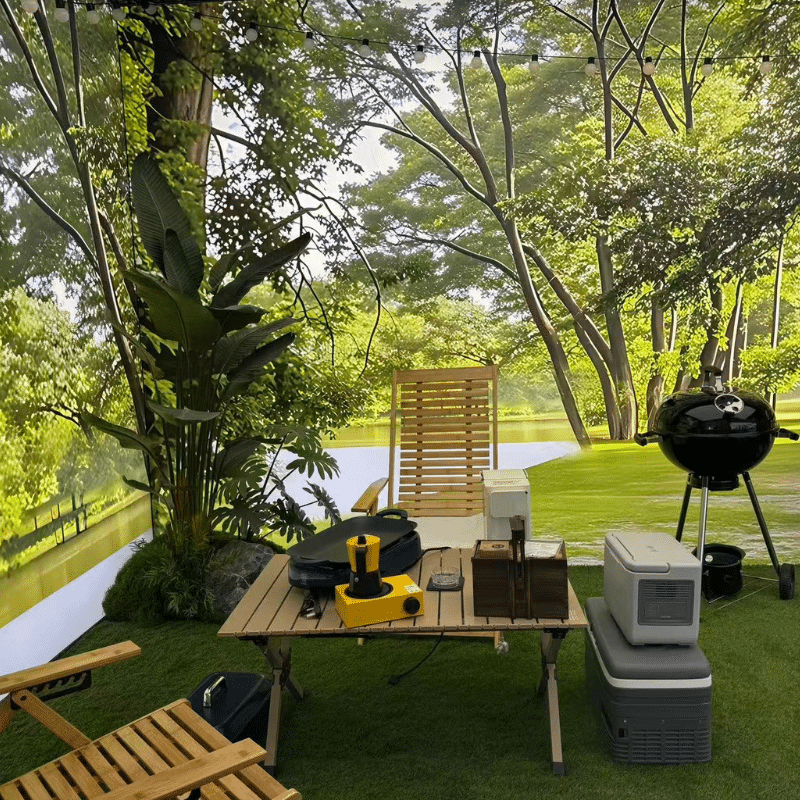
Location filmmaking is unpredictable. One day you are filming interviews in a quiet indoor space. The next day you are running lights and monitors outdoors, then moving again for a night shoot or a remote documentary setup. In these situations, power is not just about wattage. It is about mobility, noise control, reliability, safety, and how quickly your team can get set up and move again.
A portable power solution for filmmaking should help solve several real production problems. It should reduce setup friction, avoid interrupting audio recording with engine noise, support sensitive equipment with stable output, and make it easier to work in places where fuel generators are inconvenient or simply not practical. It can also simplify compliance for projects that need cleaner on-site operation, especially in environments where noise and fumes are unwelcome.
What Film Crews Usually Need to Power
The actual power demand on set depends on the production type. A solo creator filming interviews may only need to run camera batteries, a monitor, a laptop, and a few small LED lights. A commercial or documentary crew may need to support more demanding lighting setups, wireless systems, chargers, and multiple accessories throughout a full shooting day.
Typical on-location gear may include mirrorless or cinema camera battery chargers, LED lighting fixtures, on-camera monitors, field monitors, laptops for data backup, wireless video transmitters, audio gear, and phone or tablet charging. In many cases, the power system also needs to support surge loads from certain tools or additional set equipment. That is why looking only at battery capacity is not enough. Output stability and overload performance matter too.
What to Look for in Portable Power for Filmmaking on Location
When choosing Portable Power for Filmmaking on Location, the most important factor is not the marketing language. It is whether the system matches the actual needs of your production workflow.
Battery capacity is the first big checkpoint. If the capacity is too small, you will spend more time recharging and swapping than shooting. A unit in the 2kWh range is often a practical starting point for mobile crews because it can support a mix of lighting, charging, and accessory loads without becoming too large to transport. The FPG3600 offers 2304Wh capacity, and up to three units can be connected in parallel for a total of 6.9kWh, which is useful for longer shooting schedules or multi-device setups.
Rated output power is just as important. Your crew may not always need high wattage, but sudden load peaks still happen. The FPG3600 is listed at 3,600W rated output, with 20,000W peak power, which gives a large headroom for starting demanding equipment or dealing with short-term spikes. For many film crews, that means more flexibility when powering mixed loads on location rather than building the whole setup around one narrow use case.
Pure sine wave output also matters. Sensitive electronics such as battery chargers, monitors, laptops, and some camera support systems generally benefit from stable, clean power. The FPG3600 provides 230V pure sine wave output, with 230±5V voltage range and 50±0.5Hz frequency, which is a useful point for professional users who care about consistent operation.
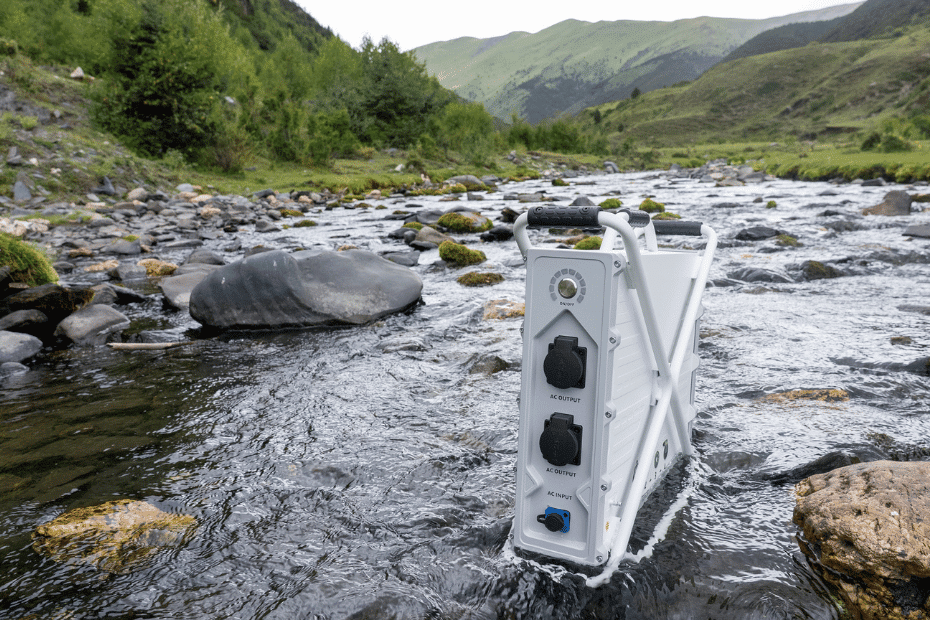
Portability is another real-world factor that gets overlooked. Crews do not just buy a machine. They carry it from vehicle to set, from one corner of a location to another, sometimes more than once per day. The FPG3600 has a net weight of 24kg and dimensions of 526 × 485 × 211 mm, which places it in a category that is still transportable for professional on-location work while offering much higher output than compact consumer units.
Environmental tolerance is also important for production crews who work outside. The unit is rated IP54, uses natural cooling, and supports discharge in temperatures down to -15°C and up to 55°C. You also noted that at 0°C, it can still discharge about 2.1kWh, although charging at that temperature is not supported. For location crews working in cold mornings, mountain areas, or winter projects, this is more practical than many basic consumer battery systems.
Why More Crews Are Moving Away from Traditional Generators
Traditional generators still have their place, especially for very high continuous power demand. But for many filming jobs, they create just as many problems as they solve. Noise is the obvious one. Sound departments do not need extra engine noise near a scene. Interview shoots, documentary work, and dialogue recording become harder when a generator is running nearby.
The second issue is exhaust and safety. CDC states that portable generators produce carbon monoxide, a colorless and odorless gas that can kill without warning. OSHA also warns against using generators indoors or in enclosed areas and emphasizes outdoor placement with adequate ventilation. For crews filming in warehouses, event spaces, temporary structures, or near building openings, this is not a small issue.
Battery-based portable power avoids direct exhaust during use and is often much better suited to quiet sets, indoor spaces, and jobs where mobility matters more than all-day unlimited runtime. That does not mean every battery unit replaces every generator. It means the right battery power station can be the better tool for a large number of film production situations.
A Practical Example: Using FPG3600 for Professional On-Location Power
The FPG3600 is built as a high-output portable power system rather than a lightweight camping unit. That difference matters on professional film sets. Filmmakers need equipment that can handle repeated use, transport, and mixed-load working conditions without becoming a weak point in production.
The unit offers 2304Wh battery capacity per unit, and up to 6.9kWh total capacity with 3-unit parallel expansion. Rated output is 3,600W, with overload capability above that range and a peak power figure of 20,000W. Charging input is 1200W, with a 1300W peak charging power. This makes it better suited to demanding professional workflows than lower-output battery products designed mainly for phones, drones, and casual travel use.
The FPG3600 also includes several practical features that matter in real use. It does not support pass-through charging, so charging and use should be planned separately. It includes CAN communication, uses an inverter structure controlled by MCU and FPGA, and comes with a charging cable, manual, and grounding cable. The app interface currently supports Chinese, English, Italian, Spanish, French, German, and Russian, which is useful for distributors and international users.
From a durability perspective, the battery is rated at 800 cycles, with approximately 80% capacity remaining after 800 cycles. When used within a 20% to 80% charge-discharge window, actual service time can go well beyond the base cycle figure, with an estimated total of around 2500 hours. That makes it a practical option for rental operators, repeat production users, and commercial teams looking at long-term value.
Shipping, Compliance, and Why Certifications Matter
For production companies, rental suppliers, and distributors, compliance is not just a technical detail. It affects whether a power system can be shipped, stored, sold, and accepted by professional buyers.
The FPG3600 has CE and UN38.3 certification, and the English parameter sheet also lists IEC 62619, IEC 62477, and IEC6100. Pre-shipment procedures include ATE testing and factory inspection reports, and customs transport standards refer to the International Dangerous Goods Rules and SN/T0370.3-2021.
This matters because lithium battery transport is regulated. Battery types must pass the applicable UN38.3 transport tests before they can be legally shipped in many markets.(Form IATA)
Battery charge for shipment should also be kept below 30%, which aligns with common transport practice for lithium battery products. For buyers in the film and broadcast industry, this adds confidence that the product is built with real export and professional distribution requirements in mind.
Real-World Performance Data Helps Buyers Trust the Product
One of the strongest ways to evaluate portable power for professional users is to look beyond general claims and focus on measured use cases. Film buyers may not always run drills, demolition hammers, or pumps, but real load testing still proves output stability and system capability.
The FPG3600 has reportedly supported a 3kW arc welding machine, running 98 weld seams with 2.5 mm electrodes at 230V. It also handled a 3.2kW core drill for up to 11 holes, a 1.4kW drill for up to 243 holes, a 2.7kW cutting saw for 41 cuts on cast iron pipe, and a 2.3kW pump delivering up to 50,000 liters at 780 liters per minute over 64 minutes. These are not filmmaking loads, but they clearly show that the unit is built for demanding real-world power delivery rather than light consumer charging only.
For film crews, this translates into confidence. If a portable power station is engineered to deal with high-power jobsite loads, it is more likely to perform steadily when asked to run lighting, monitors, charging stations, and support electronics during a production day.
Is Portable Power for Filmmaking on Location Worth It?
In many cases, yes. For interviews, documentaries, branded shoots, outdoor content creation, mobile production work, and location filming where sound quality and flexibility matter, battery-based portable power is often the smarter option. It helps crews work faster, quieter, and with less setup friction.
The right system is especially valuable when a team needs to move often, shoot in noise-sensitive environments, or work where building power is unavailable or unreliable. It is also useful when a production wants a more modern alternative to small fuel generators.
A product like the FPG3600 stands out because it is not positioned as a small lifestyle battery. It is a high-output portable power solution with 2304Wh capacity, 3,600W rated output, 20,000W peak power, IP54 protection, and parallel expansion up to 6.9kWh. Those figures make it more relevant to professional users who need dependable portable power for serious work on location.
Final Thoughts
The best Portable Power for Filmmaking on Location is not necessarily the smallest unit or the cheapest one. It is the one that fits the real shooting workflow. Film crews need more than battery capacity. They need stable output, professional-level reliability, practical mobility, safe operation, and a quieter working environment.
For filmmakers, production companies, rental partners, and media professionals, the real priorities are quiet operation, stable power, transport compliance, outdoor usability, and proven output performance. That is what makes the difference between a generic battery product and a power solution that can genuinely support modern on-location film production.
For crews that want a cleaner and more flexible alternative to traditional generators, the FPG3600 offers a strong value proposition. It is a portable, export-ready, high-output solution that is much better aligned with the realities of professional filmmaking on location.