









AC IP54 Industrial Power Station for Harsh Industrial Applications
If you search “AC IP54 Industrial Power Station”, you usually want one outcome: a portable industrial power source that can run real AC tools on dusty, splash-prone job sites without becoming a reliability risk. This page gives direct answers using FPG3600 as a reference, including what it can power, how it’s tested before shipment, what certifications are available, how to store it correctly, how it ships legally, and what limitations you must know upfront.
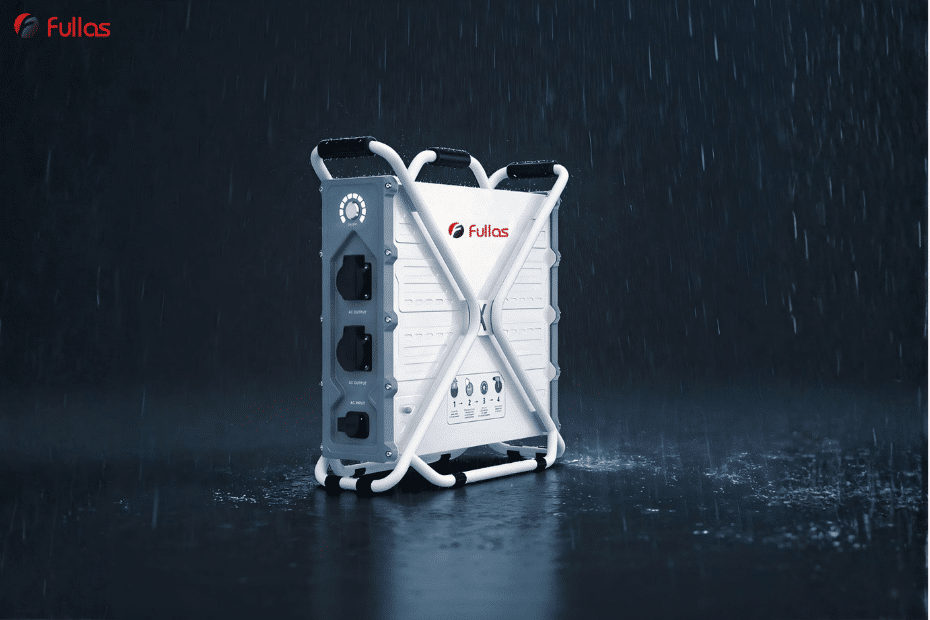
What “IP54” means in real industrial use
IP54 protects against dust and splashing water
IP54 is built for dusty and splash-prone environments: airborne dust, cutting debris, light rain, wet ground splash, and typical outdoor job-site conditions. For industrial users, the value is uptime—less downtime from dust intrusion and fewer failures from accidental splashes.
What IP54 does not mean
IP ratings are defined under IEC 60529, the global enclosure protection standard that classifies dust and water resistance levels.
https://www.zebra.com/us/en/resource-library/faq/what-is-ip-rating.html
IP54 does not mean submersion, pressure washing, or leaving the unit in standing water. If your application includes heavy water jets or immersion risks, you should choose a higher protection strategy and stricter operating procedures.
AC power for industrial work: what actually matters
Continuous vs peak output
Industrial users don’t fail because they lack “kWh”. They fail because the power source can’t start or hold a load. For AC applications, you should evaluate:
- Continuous output: the power it can hold steadily
- Peak output: the headroom for starting surge and dynamic loads
FPG3600 supports 3000W continuous and up to 20000W peak.
Charging power for faster turnaround
For shift work and rentals, charging speed affects utilization. FPG3600 supports 1200W charging, with 1300W peak charging.
Inverter system and control logic (industrial-friendly)
FPG3600 forms inverter capability through multiple small converters cascaded, with MCU + FPGA control. In practical terms, this supports stable AC output behavior and fast protection response under changing loads.
Energy capacity and scaling for longer runtime
Single-unit capacity
FPG3600 battery capacity per unit is 2.3kWh.
Expansion up to 3 units (runtime increases, power stays the same)
FPG3600 supports up to 3 units in parallel for capacity expansion. That brings total capacity to 6.9kWh. Expansion increases energy (runtime), while output power does not increase. This is the correct design for teams who need longer work time but do not need higher wattage.
Battery cell details and lifecycle expectations
Cell model and chemistry
FPG3600 uses INR21700-40TG cells, described as NCA (Nickel-Cobalt-Aluminum) ternary lithium in the provided information.
Cycle life guidance you can plan around
- Cycle life: 800 cycles (about 1600 hours as provided)
- If operated mainly between 20%–80% SOC, usable life can extend significantly, with an estimate around 2500 hours
- After 800 cycles, capacity remains ≥80% (typical end-of-life benchmark)
Pure cell pack weight
Pure cell pack weight is 11kg.
Certifications, shipping, and compliance answers
What tests happen before shipment
FPG3600 undergoes:
- ATE testing
- Factory inspection / outgoing test reports
Certifications available
- CE certification
- UN38.3 (key battery transport compliance test set)
Lithium batteries must pass UN38.3 testing before transport, including altitude, vibration, shock, and thermal tests defined by the UN Manual of Tests and Criteria.
https://cetecomadvanced.com/en/news/testing-according-safe-lithium-ion-batteries-in-transport
https://www.greatechenergy.com/news/comprehensive-guide-to-battery-product-certifi-85367853.html
Customs and dangerous goods standards referenced
For export and customs compliance, the provided references include:
- International customs dangerous goods rules
- SN/T0370.3-2021
Shipping state of charge requirement
Based on dangerous goods transport assessment and forwarder practice:
- Battery must be discharged to ≤30% before shipment
Dual-use compliance note
The provided data indicates energy metric at 205 kW/kg, which does not meet a 300 kW/kg threshold referenced in the “dual-use prohibited list” context. For strict tenders, you should still confirm the exact regulation mapping for your destination and configuration.
Operating temperature limits and what to expect in cold environments
Recommended operating temperature ranges
Provided temperature ranges:
- Battery operating temperature: Charge 5℃–55℃, Discharge -15℃–60℃
- Operating temperature: Charge 5℃–40℃, Discharge -15℃–55℃
Important limitation: 0°C cannot charge
At 0°C, charging is not supported.
Cold performance note (practical reference)
A provided internal test note says: at 0°C, the unit can still deliver about 2.1kWh, and this performance is positioned as stronger than a competing benchmark in low-temperature discharge.
Storage rules that protect battery life (important for rentals)
Correct storage checklist
Before storage:
- Turn off the device fully
- Remove connected cables and loads
For long-term storage: - Store at about 60% battery level
- Recharge at least once every 6 months
Environment: - Store at 20℃–30℃ and low humidity
Critical warning: - Leaving the unit at very low SOC for long periods can cause irreversible cell damage and shorten service life
Shipping requirement: - For logistics, keep SOC ≤30% before shipment
Connectivity, app, and system integration
Communication
- CAN communication supported
AC coupling capability (and limitation)
- Can build AC voltage coupling
- Cannot grid-tie / cannot connect to public grid, mainly due to certification constraints
No pass-through charging
- Does not support charging while discharging (no pass-through)
App and languages
- App currently supports: Chinese, English, Italian, Spanish, French, German, Russian
Remote connectivity roadmap
- Current version: Bluetooth only
- 4G/Wi-Fi: under development but not planned now due to restrictions and certification requirements in some markets
- GPS positioning: not supported
Cooling and durability in harsh industrial cycles
Faster cooling in updated design
A provided update note says the new version includes a small fan to reduce cell temperature. The fan starts automatically when internal temperature reaches a threshold, helping shorten cool-down time. In job-site use, faster cooling reduces downtime and improves daily utilization, which is meaningful for rental fleets and multi-shift operations.
Real AC load test results at 230V (what it can actually power)
The following load tests are provided for 230V AC. These examples help you estimate suitability for similar equipment and work patterns.
Welding and heavy tools
- 3kW arc welder: 230V, 98 weld seams, 2.5mm electrode
- 2.2kW demolition hammer: demolished 8.2 tons of concrete slab
- 2.7kW cutting saw: up to 41 cuts on 110mm cast iron pipe
Drilling and core drilling
- 3.2kW core drilling: 230V, up to 11 holes (150mm diameter, 150mm depth)
- 1.4kW drill: 230V, up to 243 holes (35mm diameter, 10mm depth)
Industrial cleaning and pumping
- Industrial vacuum: suction performance up to 8,500 liters
- 2.3kW pump: up to 50,000 liters, flow 780 L/min, runtime 64 minutes
After-sales and fleet support approach (for distributors and rentals)
Service model for overseas distributors
For overseas distributors with repair capability:
- Provide repair training
- Provide after-sales spare parts allocation
Recommended backup unit ratio for large distributors
For distributors with 100+ units:
- Recommend 5% backup units for temporary replacement during service/repair
Quick decision: is FPG3600 the right AC IP54 industrial power station for you
Choose it if you need
- AC power for real tools with 3000W continuous and strong surge headroom
- IP54 protection for dusty and splash-prone job sites
- Verified pre-shipment testing, export logic, and real load test references
- Runtime scaling up to 6.9kWh via 3-unit expansion, without changing power rating
FPG3600 AC IP54 Industrial Power Station – Technical Overview
| Category | Specification | Details |
|---|---|---|
| Protection Rating | IP Level | IP54 Industrial Protection |
| Continuous Power | Rated Output | 3000W Continuous AC Output |
| Peak Power | Surge Output | Up to 20000W Peak |
| Battery Capacity | Single Unit | 2.3 kWh |
| Max Expansion | Parallel Units | Up to 3 Units (6.9 kWh Total) |
| Battery Cell Type | Model | INR21700-40TG (NCA Lithium) |
| Cycle Life | Standard Use | 800 Cycles (≥80% Capacity Retention) |
| Charging Power | AC Charging | 1200W (Peak 1300W) |
| Operating Temperature | Charge | 5℃ to 55℃ |
| Operating Temperature | Discharge | -15℃ to 60℃ |
| Low Temperature Note | Charging Limit | Charging Not Supported at 0℃ |
| Communication | Data Interface | CAN Communication Supported |
| Connectivity | Remote | Bluetooth Version |
| Certifications | Compliance | CE Certification, UN38.3 |
| Shipping Requirement | SOC Level | ≤30% Battery Level for Transport |
| Cooling System | Thermal Design | Natural Cooling + Internal Fan Assist |
| Inverter System | Control Logic | MCU + FPGA Controlled Conversion |
| Accessories | Included | Charging Cable, Manual, Grounding Wire |
FAQ
What testing is done before FPG3600 ships
ATE testing and factory outgoing inspection reports are provided as the standard pre-shipment process.
What certifications does FPG3600 have
CE certification and UN38.3 are provided.
What is the battery capacity and max expandable capacity
Single unit is 2.3kWh. Up to 3 units can be expanded for a total of 6.9kWh.
What load can FPG3600 support
3000W continuous load, with up to 20000W peak headroom for surge demand.
Can FPG3600 charge and discharge at the same time
No. It does not support pass-through charging.
What temperature range can it operate in
Charge 5℃–55℃ and discharge -15℃–60℃ are provided as battery operating temperature ranges. Charging at 0℃ is not supported.
How should it be stored for long-term life
Power off, remove loads, store at about 60% SOC, recharge at least every 6 months, store in 20℃–30℃ low-humidity environment, and avoid long-term low SOC.
What SOC is required for shipping
Discharge to ≤30% before shipment.