









Understanding 999cc Engine Displacement and Performance
A 999cc displacement falls into the mid-to-large engine range and is commonly found in V-Twin configurations. Its typical advantages include stronger low-RPM torque and more stable performance under load, making it well-suited for commercial and industrial applications that require continuous power output. If you’re selecting an engine for generators, commercial lawn equipment, or power machinery, understanding the relationship between 999cc displacement and real-world performance can help you make a faster, more accurate decision.
What Does 999cc Mean in an Engine?
999cc refers to an engine’s total displacement (measured in cubic centimeters, cc). Displacement is not “fuel tank size,” and it’s not “speed.” It describes the total volume of air-fuel mixture the cylinders can draw in and compress during a full operating cycle. In simple terms: the larger the displacement, the more mixture the engine can process per cycle, which generally means more potential energy output.
But here’s the key point: displacement does not automatically equal more power. Displacement sets the “potential,” while the real performance depends on factors like cylinder count, engine layout (V-Twin / inline / single-cylinder), compression ratio, intake and exhaust efficiency, ignition and fuel control, RPM range, cooling, and overall durability design.
999cc Engine Performance: What You Can Expect
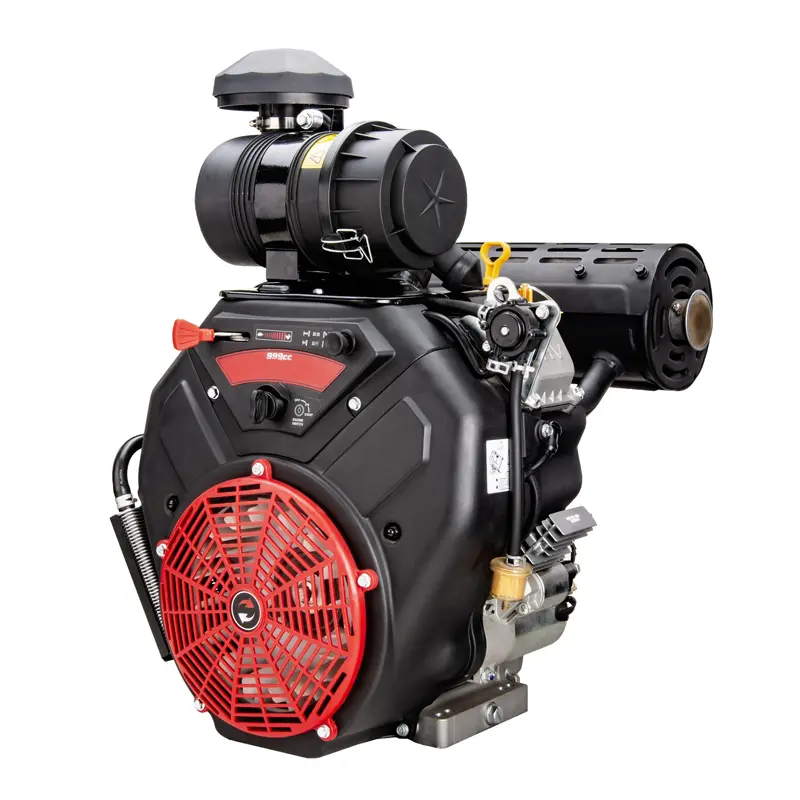
If you ask, “What can a 999cc Engine actually do?” the most useful answer is how it behaves under load. In many cases, a 999cc V-Twin is chosen for applications that need torque, stability, and long run time. You can usually expect these characteristics:
1) Stronger low-end torque
Many industrial machines don’t need extreme RPM. They need steady pulling power. With 999cc displacement plus a V-Twin design, you often get stronger low-RPM torque, making starts smoother and heavy loads easier to handle.
2) Better load stability
In generators, hydraulic pumps, and commercial lawn equipment, load changes happen constantly. A larger displacement engine can often maintain output without needing to “push RPM hard,” so performance stays smoother and speed drop is reduced under sudden load.
3) More suitable for continuous work
With proper engineering (strong structure, effective cooling, stable lubrication, good filtration), a 999cc-class engine is typically more capable for long operating hours and demanding duty cycles.
One clear takeaway: the advantage of a 999cc Engine is not “higher top speed,” but “stronger load-handling, smoother output, and better suitability for continuous work.”
Displacement vs Power: Why 999cc Doesn’t Always Mean More Horsepower
Many people treat cc as horsepower (HP), but that can lead to the wrong choice. A better way to understand it:
- Displacement (cc): the engine’s “air-fuel processing capacity”
- Horsepower (HP): how fast the engine can do work at a certain RPM
- Torque: the engine’s “pulling strength,” which matters most for load
Even with the same 999cc displacement, different tuning can produce different results:
- Torque-focused tuning: better for heavy loads and commercial equipment
- High-RPM tuning: higher peak horsepower, but not always better for industrial use
So if your goal is generators, commercial mowers, pumps, or power equipment, you should pay more attention to torque curve, rated output stability, fuel efficiency, cooling, durability, and maintenance convenience, rather than only chasing a peak horsepower number.
Why V-Twin Matters for a 999cc Engine
Many 999cc engines use a V-Twin layout for practical reasons—especially in commercial and industrial equipment.
- Smoother power delivery: two cylinders working together can feel more stable under load
- Better fit for heavy-duty cycles: many V-Twin platforms are designed with commercial duty in mind
- Flexible integration: easier to engineer around cooling, mounting, and drivetrain needs across different machines
If you want to learn more about horizontal-shaft setups and V-Twin engine solutions for commercial equipment, you can check this page:
Fullas Horizontal V-Twin Engine
This is a useful next step if you’re moving from “basic understanding” to “real selection and integration.”
Common Applications of a 999cc Engine
Here are common, high-interest application areas for a 999cc Engine—especially for OEM and B2B buyers:
- Portable / standby generators: stability under load, fuel efficiency, steady RPM
- Commercial lawn equipment: strong low-end torque, durability, heat control for long runs
- Construction & industrial equipment: reliability, serviceability, long duty cycles
- Pumps / hydraulic power units: torque, stable RPM, consistent working output
If your job requires “carry load, stay stable, run long,” a 999cc engine is often a better fit than smaller displacement options—assuming you match the right configuration and features.
How to Choose the Right 999cc Engine (Simple Checklist)
To make selection simple, here’s a practical checklist:
- Do you need more torque or more high-RPM horsepower?
- Is your duty cycle short bursts, or continuous operation?
- Do you need stable response under load (for example, generator frequency/voltage stability)?
- Mounting type: horizontal shaft vs vertical shaft—does it match your machine?
- Maintenance: are filters, spark plugs, and oil service easy to access?
- Environment: temperature, dust, humidity, and altitude—will they affect cooling and output?
Answer these first, then compare specs and options. That approach is faster and avoids mis-matching.
Final Answer: Is a 999cc Engine “Worth It”?
Here’s the clear conclusion: if your equipment needs stronger load capability, steadier output, and a power platform that’s better for continuous duty, a 999cc Engine is often a smart choice. Its value is not just “bigger displacement,” but how it performs in real working conditions—stable, capable, and durable. When 999cc displacement is paired with a well-matched V-Twin configuration and a suitable horizontal-shaft solution, its benefits in commercial and industrial applications become even more obvious.
You may also be interested in this article: