









Portable Power Stations vs Traditional Generators
Portable Power Stations vs Traditional Generators: Which One Is Better for Real Job Sites?
Power decisions on real job sites are changing fast. Traditional generators have been the default for years, but more teams now use a Portable Power Station for daily field work because they need faster deployment, cleaner operation, and better mobility. The right choice depends on task type, runtime profile, and site conditions.
Portable Power Station or Traditional Generator?
Traditional generators are better for long-duration, fuel-supported, continuous operation. A Portable Power Station is better for quiet, mobile, fast-deployment, and practical on-site tasks. For many modern teams, both can work together, but for high-frequency mobile work, a Portable Power Station is often the first choice.
What Is the Core Difference?
The key difference is how power is delivered and how work is executed on site. Traditional generators convert fuel into electricity and can keep running with fuel supply. A Portable Power Station stores energy and provides stable output instantly, with easier transport and easier setup.
Traditional Generators: Strengths
Traditional generators perform well in long-hour operation, heavy base-load tasks, and remote environments where fuel logistics are already in place. They are effective for continuous demand over extended shifts.
Portable Power Station: Strengths
A Portable Power Station performs well in flexible deployment, quick start, low-noise operation, and multi-point daily movement. It is suitable for teams that need power exactly where work happens, without complex setup.
You can take a look at the product testing video of the FULLAS FPG3600.
Why Portable Power Station Demand Is Growing
Worksites are more dynamic than before. Teams often move between multiple locations in one day. In this workflow, setup time becomes cost, mobility becomes efficiency, and operating noise becomes a practical constraint. A Portable Power Station addresses these daily realities directly.
Faster Deployment in Real Workflows
When power is needed immediately, a Portable Power Station reduces transition time between task points and supports faster execution.
Better Site Experience
Low-noise operation improves communication, reduces friction in shared environments, and fits noise-sensitive scenarios better than many traditional setups.
Practical Mobility
A Portable Power Station is easier to reposition during active operations, which helps teams maintain workflow continuity.
FULLAS FPG-3600 as a Job-Site Portable Power Station
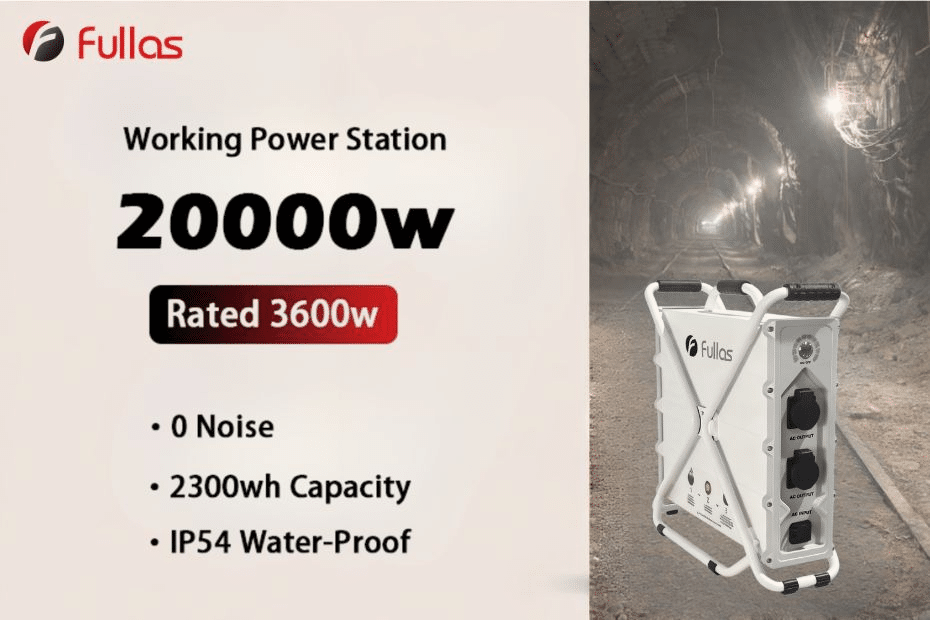
For teams that need practical field performance, FULLAS FPG-3600 is designed for real on-site use. It is built around mobility, instant peak support, stable output, and reliable operation under demanding conditions.
Key Working Specifications
- 20000W peak power
- 3600W rated output
- 2300Wh battery capacity
- IP54 water-resistant design
Why It Fits Real Job Sites
The FULLAS FPG-3600 includes an exclusive trolley design for easier transport and supports high-load tools when peak demand appears. It is a practical Portable Power Station for construction, maintenance, events, and emergency backup scenarios.
The power station FPG3600 can also operate in very harsh environments. Please watch the video.
Application Scenarios: Where Each Option Fits Best
Choosing power equipment by scenario is more effective than choosing by one number alone.
Construction and Maintenance
If teams move frequently across points, a Portable Power Station improves speed and deployment efficiency. For fixed long-duration heavy tasks, traditional generators remain important.
Events and Temporary Operations
When stable and low-noise power is required, a Portable Power Station is often the more suitable option.
Emergency Backup
When fast response and mobility matter, a Portable Power Station provides immediate usable power at the point of need.
Selection Framework for Buyers and Project Teams
Use a simple decision logic based on real operations.
Choose Traditional Generators When
You need long continuous runtime, high sustained load, and fuel-based operating continuity.
Choose a Portable Power Station When
You need rapid deployment, low-noise operation, frequent relocation, and practical day-to-day flexibility.
Use Both When
You run mixed workloads: traditional generators for long heavy-duty baseline, and a Portable Power Station for mobile high-frequency task points.
Final Verdict
Portable Power Stations vs Traditional Generators is not a one-winner comparison. It is a task-matching decision. Traditional generators lead in long fuel-based runtime. A Portable Power Station leads in mobility, quiet operation, and fast deployment. For real modern job sites, both have value, but for portable daily efficiency, FULLAS FPG-3600 is a direct and dependable choice.
Conclusion
If your team needs practical, stable, and mobile field power, choose a Portable Power Station built for real work. FULLAS FPG-3600 is designed to move with the job and deliver power where and when it matters most.