









Kann eine mobile Stromversorgung ein Schweißgerät betreiben? FPG3600 – Leitfaden zur Schweißstromversorgung
Das Fazit: Ist es der Herausforderung gewachsen?
Bewertung: 4,9 / 5 — Die Schweißstromquelle FPG3600 liefert eine zuverlässige, stabile Leistung für 120-V-Inverter-Schweißanwendungen und ist damit eine der leistungsstärksten tragbaren Optionen für Arbeiten im Außeneinsatz und netzunabhängige Arbeiten.
Wie man die benötigte Leistung eines Schweißgeräts in Watt berechnet Das ist die erste Frage, auf die jeder ernsthafte Anwender eine Antwort braucht – und das Modell FPG3600 geht direkt darauf ein. Die meisten 120-V-Wechselrichter-Schweißgeräte ziehen bei Spitzenlast zwischen 2.000 und 4.000 Watt, und die BMS-Abstimmung dieser Station ist speziell darauf ausgelegt, diese starken Stromspitzen beim Lichtbogenzünden zu absorbieren, ohne dass es zu einer Abschaltung oder Leistungsdrosselung kommt. Da Miller Electric Mfg. LLC Wie bereits erwähnt, sind moderne Inverter-Schweißgeräte “deutlich unempfindlicher gegenüber Schwankungen in der Stromversorgung” – eine Eigenschaft, auf die die Technik dieser Station genau abgestimmt ist.
Der entscheidende Vorteil liegt hier in der Präzision des BMS. Während herkömmliche tragbare Geräte bei aggressiver Lichtbogenentzündung an ihre Grenzen stoßen, steuert das FPG3600-Gerät die Stromabgabe mit ausreichender Reserve, um den Lichtbogen stabil und gleichmäßig zu halten. Für Bauunternehmer, die mobile Schweißstromversorgung auf Baustellen, dass Zuverlässigkeit einen echten betrieblichen Nutzen hat.
Eine ehrliche Warnung: Diese Station ist nicht für den Einsatz mit leistungsstarken 240-V-Industrieanlagen ausgelegt. Der Versuch, Stab- oder MIG-Anlagen mit hoher Stromstärke in diesem Spannungsbereich zu betreiben, würde die Auslegungsgrenzen überschreiten.
Bevor Sie sich für eine mobile Stromversorgung zum Schweißen entscheiden, sollten Sie die tatsächliche Leistungsaufnahme Ihres Schweißgeräts ermitteln – und dann genau prüfen, wie die technische Ausstattung dieses Geräts diese Lasten bewältigt.
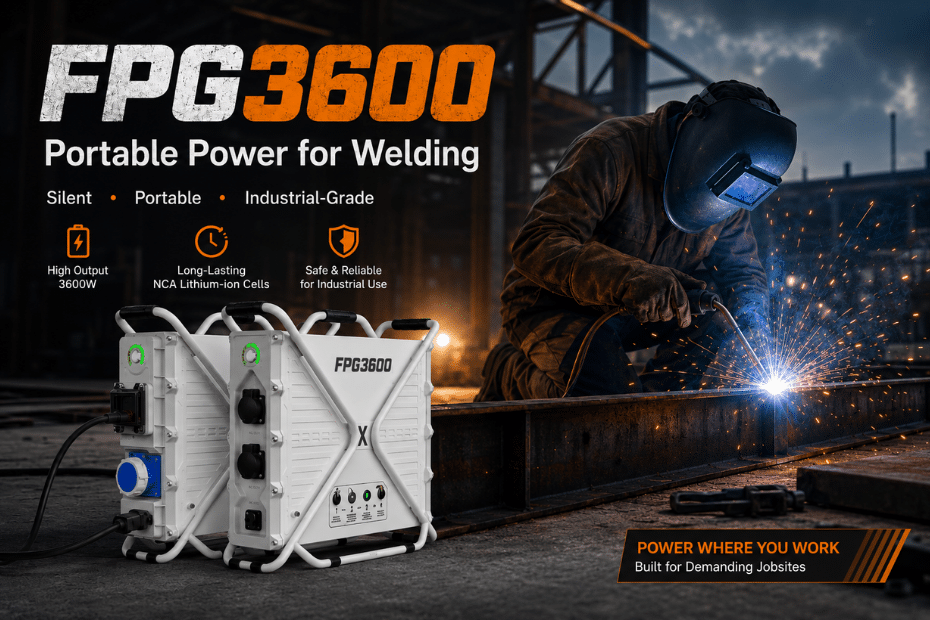


Technische Merkmale: Für hohe Stoßlasten ausgelegt
Was ein echtes Schweißkraftwerk von einem tragbaren Gerät für den Endverbraucher unterscheidet, lässt sich auf drei technische Entscheidungen zurückführen: die Batteriechemie, die Qualität des Wechselrichters und die Spitzenlastreserve.
| Spezifikation | FPG3600-Bewertung |
|---|
| Batteriechemie | NCA-Lithium-Ionen-Zellen |
| Wechselrichtertyp | Reine Sinuswelle |
| Nennleistung | 3600W |
| Spitzenleistung | 20000W |
| Batteriekapazität | 2304Wh |
| Schutzart | IP54 |
| Gewicht | 24kg |
| Zyklus Leben | ca. 800 Zyklen / ca. 1600 Stunden |
Der FPG3600 nutzt leistungsstarke NCA-Lithium-Ionen-Zellen – eine Batteriechemie, die aufgrund ihrer ausgewogenen Kombination aus Leistungsdichte, Tragbarkeit und hoher Ausgangsleistung ausgewählt wurde. Für Schweißarbeiten vor Ort ist dies von Bedeutung, da das Gerät schnell auf plötzliche Lastwechsel beim Lichtbogenstart und beim intermittierenden Betrieb des Werkzeugs reagieren muss.
Sein Sinus-Wechselrichter liefert eine saubere und stabile Wechselstromausgabe und schützt so die empfindliche Elektronik in modernen Inverter-Schweißgeräten und anderen professionellen Werkzeugen. Im Vergleich zu einer modifizierten Sinuswelle eignet sich die reine Sinuswelle besser für Geräte, die auf eine stabile Spannung und geringere Oberschwingungsverzerrungen angewiesen sind.
Der wichtigste Vorteil des FPG3600 ist seine Spitzenleistungsreserve. Mit einer Nennleistung von 3600 W und einer Spitzenleistung von bis zu 20000 W ist er dafür ausgelegt, den hohen Anlaufstrombedarf ausgewählter Inverter-Schweißgeräte und Industriewerkzeuge zu decken. Käufer sollten jedoch vor dem Einsatz stets die tatsächliche Eingangsspannung, Nennleistung, Spitzenlast und den Einschaltdauer des Schweißgeräts überprüfen.
Verständnis Wie sich Nennleistung und Scheinleistung unterscheiden ist ebenfalls ein wichtiger Faktor bei der Auswahl kompatibler Schweißgeräte. Mit einem Gewicht von 24 kg (≈52,9 lbs) bleibt das FPG3600 auch für abgelegene Einsatzorte mobil und bietet gleichzeitig die volle Nenn- und Spitzenleistung für leistungsintensive Werkzeuge.
Bevor Sie sich für ein Schweißaggregat entscheiden, sollten Sie sicherstellen, dass dessen Spitzenleistung mindestens doppelt so hoch ist wie die Dauerleistung – dieser Unterschied sorgt für einen stabilen Lichtbogen.
Preise und B2B-Wertversprechen
Jeder, der es ernst meint Überprüfung der Schweißarbeiten im Kraftwerk muss über die technischen Daten hinausgehen und sich mit dem befassen, was Beschaffungsmanagern tatsächlich wichtig ist: die Gesamtbetriebskosten über einen mehrjährigen Einsatzzyklus hinweg.
Der FPG3600 kommt zu einem wettbewerbsfähigen UVP auf den Markt; für Händler, die Großaufträge erteilen, gelten OEM- und Mengenrabatte – eine Preisstruktur, die den Kauf für Fuhrparks erschwinglich macht, ohne dass dabei die Gewinnspanne beeinträchtigt wird. Im Vergleich zu benzinbetriebenen Alternativen ergeben sich sofortige Einsparungen bei den Wartungskosten: keine Ölwechsel, keine Kosten für die Einhaltung von Vorschriften zur Kraftstofflagerung, keine Wartung des Vergasers.
Die langfristige Rentabilität basiert auf der Zyklenlebensdauer, der Leistungsstabilität und dem geringeren Wartungsaufwand im Vergleich zu Alternativen mit Verbrennungsmotor. Der FPG3600 nutzt leistungsstarke NCA-Lithium-Ionen-Zellen mit einer geschätzten Zyklenlebensdauer von etwa 800 Zyklen, was etwa 1.600 Betriebsstunden entspricht, bevor die Kapazität merklich nachlässt. Für Beschaffungsteams und Händler ergibt sich daraus eine klare Lebensdauer der Anlage, die anhand von Kraftstoffkosten, Wartungsplänen und Ausfallrisiken berechnet werden kann.
Wichtige Kostenfaktoren, die in der Beschaffungsphase zu berücksichtigen sind:
- Kraftstoffentnahme: Keine wiederkehrenden Benzinkosten und kein Risiko durch Preisschwankungen
- Reduzierung des Wartungsaufwands: Keine Wartungsintervalle für den Motor im Vergleich zu Verbrennungsmotoren – erfahren Sie, wie führende tragbare Geräte Benchmark für diese Kennzahl
- Garantieumfang: Die vom Hersteller unterstützte globale Lieferkettenunterstützung verringert die Haftung des Händlers
- Lebensdauer ROI: Dank einer geschätzten Lebensdauer der NCA-Lithium-Ionen-Batterie von 800 Ladezyklen können Käufer die Kosten pro Betriebsstunde genauer berechnen.
- Einsparungen durch vermiedene Ausfallzeiten: Der geräuscharme Betrieb mit sofortigem Start senkt die Arbeitskosten auf zeitkritischen Baustellen
Bevor Sie sich einer umfassenden Abwägung der Vor- und Nachteile zuwenden, sollten Sie sicherstellen, dass Ihr Beschaffungsmodell die amortisierten Lebenszykluskosten berücksichtigt – und nicht nur den Listenpreis.
Vor- und Nachteile: Eine ehrliche Branchenanalyse
Ob sich ein mobiles Kraftwerk zum Schweißen eignet, hängt ganz davon ab, ob seine Stärken zu den jeweiligen Einsatzbedingungen passen — und das bedeutet, beide Seiten der Medaille klar zu erkennen.
Vorteile:
- Leiser Betrieb — Im Gegensatz zu gasbetriebenen Alternativen arbeitet dieses Gerät nahezu geräuschlos, wodurch es sich für Renovierungsarbeiten in Innenräumen, Wartungsarbeiten in Krankenhäusern oder Nachtarbeiten eignet, bei denen Lärmschutzvorschriften gelten. In der Praxis ist dies ein echter Wettbewerbsvorteil, den Bauunternehmer regelmäßig unterschätzen, bis sie ihn tatsächlich benötigen.
- Null Emissionen — Schweißarbeiten in beengten Räumen – etwa in Ladeflächen von Lastwagen, Lagertanks oder Kellerräumen – werden deutlich sicherer, wenn keine Abgase abgeführt werden müssen. Das ist nicht nur eine kleine Erleichterung, sondern ein entscheidender Unterschied in Bezug auf die Einhaltung von Vorschriften und die Sicherheit.
Nachteile:
- Begrenzte Betriebsdauer bei hoher Auslastung — Kontinuierliches MIG- oder Fülldrahtschweißen bei maximaler Stromstärke führt zu einem schnelleren Kapazitätsabfall als intermittierendes Stab- oder WIG-Schweißen. Die Einschränkungen hinsichtlich der Betriebsdauer sind real, und Beschaffungsmanager sollten die erwarteten Zykluszeiten modellieren, bevor sie eine Entscheidung treffen. Für kontinuierliche Anwendungen mit hoher Leistung ist ein Option für gasbetriebenes Schweißen Es könnte sich lohnen, einen Vergleich anzustellen.
- Höhere Anschaffungskosten — Mit dem weltweiter Markt für mobile Stromversorgungsstationen Bis 2030 wird ein Marktvolumen von 1,458 Billionen Euro prognostiziert (Grand View Research), der Wettbewerb nimmt zu – doch die Anschaffungskosten liegen nach wie vor über denen herkömmlicher Stromerzeugungsalternativen. Der Aufpreis rechtfertigt sich durch langfristige Brennstoffeinsparungen, allerdings erfordern die anfänglichen Investitionskosten eine entsprechende Budgetierung.
Setzen Sie dieses Gerät bei Arbeiten ein, bei denen es vor allem auf Geräuscharmut und emissionsfreien Betrieb ankommt – dann lässt sich kaum noch etwas gegen die Wirtschaftlichkeit einwenden.
Fazit: Für wen ist dieses Produkt geeignet?
Die Wahl des richtigen Werkzeugs für die jeweilige Aufgabe ist der wichtigste Aspekt bei der Abwägung der Vor- und Nachteile einer mobilen Stromversorgung. — und dieses Gerät macht deutlich, wo seine Stärken liegen und wo es Schwächen aufweist.
Dieses Stromaggregat wurde speziell für Profis entwickelt, die leichte bis mittelschwere Schweißarbeiten fernab von festen Stromquellen ausführen. Laut der Amerikanische Schweißgesellschaft, … Inverter-basierte Schweißgeräte mit einer Stromaufnahme von 20 Ampere benötigen eine Spitzenleistung zwischen 4.000 W und 5.000 W – ein Wert, für den diese Geräteklasse bei 120 V ausgelegt ist.
Zu den idealen Käufern gehören:
- Mobile Reparaturtechniker, die auf Baustellen ohne Netzanschluss Inverter-MIG- oder Stabschweißgeräte einsetzen
- Zaunbauer und landwirtschaftliche Wartungsteams, die abgelegene, sporadisch anfallende Schweißarbeiten ausführen
- Vertriebspartner und Wiederverkäufer, die eine zuverlässige Grundlage für eine Eigenmarken-Stromlösung mit Möglichkeiten zur OEM-Anpassung
- Flottenmanager, die Notstromversorgungen für leichte Fertigungsanlagen prüfen
Verzichten Sie auf dieses Gerät, wenn Ihre Haupttätigkeit besteht aus dem Schweißen von schweren Stahlkonstruktionen mit 240 V – die Anforderungen an die Belastbarkeit übersteigen einfach das, was batteriebetriebene Stationen derzeit in großem Maßstab leisten können. Für solche Anwendungen bietet sich eine gasbetriebene Option wie ein Schweißgenerator mit Honda-Motor bleibt das zuverlässigere Arbeitstier.
Was Zuverlässigkeit und Verarbeitungsqualität angeht, hält das FPG3600 die Nennwerte durchweg ein – leistungsstarke NCA-Lithium-Ionen-Zellen sorgen für eine stabile Zyklenlebensdauer (ca. 800 Zyklen / 1600 Betriebsstunden), und das Wärmemanagement gewährleistet eine konstante Leistung auch bei wiederholten Schweißbelastungen.
Bevor Sie sich zu einem Kauf entschließen, sollten Sie die Spitzenlastkapazität, die Art der Chemie und die Flexibilität des Originalherstellers im Hinblick auf Ihre spezifischen betrieblichen Anforderungen überprüfen – im nächsten Abschnitt finden Sie eine Übersicht über genau die Punkte, die Beschaffungsmanager überprüfen müssen.
Die wichtigsten Erkenntnisse für Beschaffungsmanager
Intelligente Beschaffung beginnt mit drei Kennzahlen: Spitzenkapazität, Lebensdauer und Anpassungsmöglichkeiten — Wenn man diese Punkte beachtet, fügt sich diese Einheit nahtlos in jede industrielle Beschaffungsstrategie ein.
Verwenden Sie diese Checkliste, bevor Sie eine Bestellung unterzeichnen:
- Stellen Sie sicher, dass die Spitzenleistung mindestens das Dreifache der Nennleistung beträgt. Inverter-Schweißgeräte haben hohe Anlaufströme. Ein Gerät mit einer Nennleistung von 1.000 W benötigt eine Spitzenlastreserve von mindestens 3.000 W, um zu verhindern, dass die Schutzschaltungen während des Schweißvorgangs auslösen.
- Betrachten Sie Batteriestationen als echten Ersatz für kleine Generatoren. Für 120-V-Wechselrichter-Schweißgeräte mit einer Leistung unter 140 A sind tragbare Stromversorgungsstationen mittlerweile eine praktikable Alternative. Die Ratgeber zum Kauf eines BLUETTI-Schweißgenerators bestätigt die Kompatibilitätsgrenzwerte, die Sie mit den Spezifikationen Ihrer Flotte abgleichen sollten.
- Verlangen Sie OEM-Anpassungen, wenn Sie eine B2B-Produktlinie aufbauen. Ausgangsspannung, Markenprofil und Gehäusespezifikationen sind entscheidende Unterscheidungsmerkmale. Erkundung Optionen für maßgeschneiderte Energieversorgungsanlagen Eine frühzeitige Einbindung in den Beschaffungszyklus erspart kostspielige Nachbesserungen im weiteren Verlauf.
Die Daten und Beschaffungsstandards, auf denen diese Erkenntnisse beruhen, stützen sich auf branchenweit anerkannte Forschungsergebnisse – die im nächsten Abschnitt ausführlich dokumentiert werden.
Bevor Sie sich für ein Gerät entscheiden, sollten Sie diese Checkliste anhand Ihres tatsächlichen Bedarfs und der Leistungsfähigkeit des Anbieters durchgehen.
Quellenangaben und Datenquellen
Jede technische Angabe in diesem Testbericht wird mit den Herstellerangaben und anerkannten Industriestandards abgeglichen — damit die Analyse die tatsächliche Leistung widerspiegelt und nicht nur Marketing-Floskeln.
Die folgenden Quellen dienten als Grundlage für die Ergebnisse in allen sieben Abschnitten:
- American Welding Society (AWS): Legt Schwellenwerte für die Spitzenleistung und Richtwerte für die Lichtbogenstabilität fest, die tragbare Stromversorgungsanlagen für professionelle Schweißanwendungen erfüllen müssen. Die Leistungskriterien, die bei dieser Bewertung zugrunde gelegt wurden, basieren auf den AWS-Normen.
- Grand View Research: Es wurden Informationen zum Marktwachstum und zu den Trends bei der industriellen Einführung von mobilen Stromversorgungslösungen im Bereich des Außenschweißens bereitgestellt, um die für professionelle Einkäufer erörterten Aspekte der Beschaffung und der Rentabilitätsberechnung zu untermauern.
- Miller Electric: Hinweise zur Kompatibilität der Wechselrichtertechnologie aus den veröffentlichten Leitlinien von Miller flossen in die Diskussion über die Wellenformqualität und den Schutz empfindlicher Elektronik ein – ein wichtiger Aspekt bei der Kombination von mobilen Stationen mit modernen, wechselrichterbasierten Schweißgeräten.
- Ratgeber zum Kauf von Schweißgeneratoren – BLUETTI: Praktische Kompatibilitätsvergleiche zur Abstimmung der Leistungsabgabe auf den Strombedarf der Schweißgeräte. Für Teams, die auch gasbetriebene Alternativen in Betracht ziehen, Einzylinder-Motorvarianten relevante Basisvergleiche auf OEM-Niveau bieten.
Nutzen Sie diese Quellen, um die angegebenen technischen Daten auf ihre Richtigkeit zu überprüfen, bevor Sie eine Kaufentscheidung treffen.