


Can a Portable Power Station Run an Air Compressor? A Jobsite Sizing Guide
Yes, a suitable portable power station can run an air compressor. The decision depends on the exact compressor, its starting requirements and the work you need to finish. Enough battery capacity does not guarantee a successful start. A successful start does not establish how long the setup will keep working.
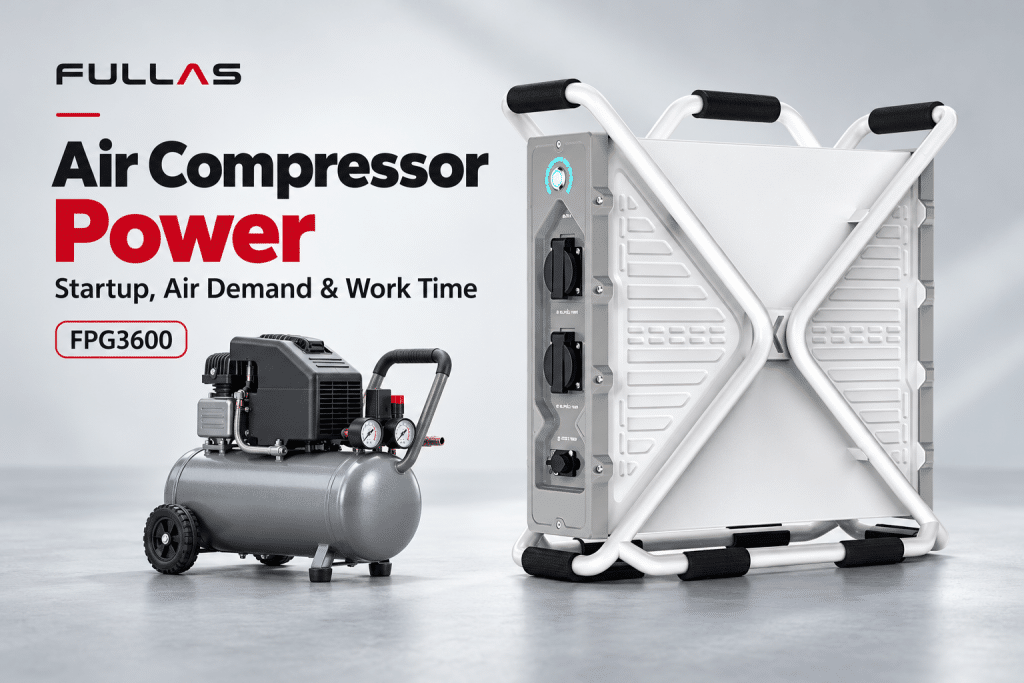
For a contractor or mobile technician, three questions matter: Can the supply start the compressor reliably? Can the compressor deliver enough air for the tools? Will the battery cover the task before the next recharge?
This guide focuses on portable electric tank compressors used with jobsite air tools. A tire inflator, an airbrush compressor and a large workshop compressor are different loads. Use the actual equipment details rather than a generic compressor wattage chart.
Start with the air tool and the job
Write down what the crew will do: occasional trim nailing, repeated fastening, blowing off equipment or another defined task. Include which tools run together and the time available to finish.
Then compare each tool’s required airflow and working pressure with the compressor’s delivered airflow at that pressure. Ingersoll Rand’s sizing guide explains why CFM and PSI are more useful starting points than horsepower alone.
A larger tank can buffer air demand, but it does not make the pump produce more air continuously. If demand outruns delivery, increasing the power station’s battery size will not fix the air-supply problem.
Keep these requirements separate:
| Requirement | What it tells you | What to obtain |
|---|---|---|
| Air delivery | Whether the compressor can support the tools | Compressor output and tool consumption at the required pressure |
| Electrical output | Whether the supply can start and operate the compressor | Both manufacturers’ input/output requirements and starting limits |
| Usable energy | Whether the planned task fits between recharges | Relevant AC energy data and the actual operating pattern |
Also check the compressor’s permitted duty cycle. Your estimate of how often its pump will run must stay within the manufacturer’s operating limits. A battery supply does not remove those limits.
Check the electrical match before estimating runtime
Match the market version and connection
Check voltage, frequency, plug type and the rating of the individual outlet. The total inverter rating does not automatically apply through every receptacle, adapter or distribution lead. Confirm the complete connection with the supplier.
Use the compressor’s electrical input specifications. A horsepower label is not a direct statement of electrical demand. If the nameplate gives only voltage and current, ask the supplier to assess the actual load and starting requirement rather than treating every amp reading as a wattage figure.
Check the starting event
The motor’s starting demand can exceed its running demand. A headline surge number is useful only when its duration and operating conditions match the load. Do not assume the same starting multiplier applies to every compressor.
Ask for compatibility evidence for the actual pairing. If measurement is needed, have a qualified person capture the starting event with suitable equipment. Fluke’s inrush-current guidance explains why this is a different measurement from ordinary running current.
For the wider electrical checks, use FULLAS’s Checklist voor de compatibiliteit van gereedschap in industriële elektriciteitscentrales.
Include normal automatic restarts
A tank compressor may restart while the operator continues working. Check those normal cycles and any other equipment sharing the supply. Starting tools separately at the beginning of the job does not prevent their automatic cycles from overlapping later.
Follow the compressor’s normal controls. Do not adjust pressure settings or disable protection to make a pairing work. If the first fill succeeds but a later start fails, record exactly what happened before choosing a larger power station.
If it stops, identify what stopped
Separate a power-station shutdown from the compressor stopping or failing to restart. Record the indicator, error message, battery level and timing. A single symptom is not enough to diagnose the cause.
| Observation | Useful next check |
|---|---|
| The station reports an overload during startup | Compare the actual starting requirement with the permitted output; include other connected equipment |
| The station stays on but the motor hums or starts slowly | Stop the attempt and follow the compressor’s supply-voltage and starting-system troubleshooting instructions |
| The compressor stops after sustained use | Check its operating limits and the manufacturer’s thermal-protection instructions |
| Failure appears after adding a long lead | Check that the lead and connections meet both manufacturers’ requirements |
These are investigation routes, not diagnoses. The California Air Tools 8010 manual, for example, lists different supply, temperature and head-pressure causes. Its procedures apply to that model; use the correct manual for your compressor.
Do not repeatedly force a stalled motor to restart or bypass a protective device. Persistent problems need the equipment supplier or a qualified service technician.
Estimate energy from pump-on time
The time spent at a job is not necessarily the time the compressor motor runs. For a cycling compressor, estimate energy from the actual pump-on periods, then include other loads connected to the station.
Illustrative calculation, not a product test: suppose a task lasts two hours. The hypothetical compressor draws an average of 1,200W while pumping and pumps for 30 minutes in total. Other equipment averages 40W throughout the task. These are assumed inputs, not measured FPG3600 results.
| Load or allowance | Calculation | Energy |
|---|---|---|
| Compressor pumping | 1,200W × 0.5 hour | 600Wh |
| Other equipment | 40W × 2 hours | 80Wh |
| Connected-load subtotal | 600Wh + 80Wh | 680Wh |
| Chosen planning reserve | Illustrative allowance | 200 Wh |
| Target usable AC energy | 680Wh + 200Wh | 880Wh |
The reserve is a chosen allowance, not a universal requirement or an efficiency factor. Account for any additional compressor standby consumption if it exists. Compare the result with usable energy delivered at the station’s AC output under relevant conditions, rather than treating nominal battery capacity as fully available output.
If the same assumed compressor pumps for a full hour instead, its pumping energy becomes 1,200Wh. With the same other load and reserve, the target rises to 1,480Wh. This is why the actual air-tool workload matters so much.
Do not apply a convenient duty percentage to every job. Record the work, pump-on time and starting and finishing tank pressures. A task that starts with a full tank and ends with an empty one has used stored compressed air as well as electricity.
For the broader energy-planning method, see portable power station runtime on construction sites. Neither the calculation above nor nominal capacity establishes a specific compressor’s compatibility.
Waar de FULLAS FPG3600 past
FULLAS lists 3,600W rated output and 2,304Wh nominal battery capacity for the FPG3600 industriële draagbare krachtcentrale. Those specifications help screen a possible application; they do not establish usable AC energy or approval for every compressor. Confirm the exact market version and outlet configuration before ordering.

For a proposed compressor setup, ask FULLAS to review the compressor nameplate, manual, air tools and work schedule. Request relevant starting and repeated-operation evidence for that configuration. Also agree on how the station will recharge between jobs; do not assume continuous operation while it is charging.
For rental fleets, include the approved compressor, leads and operating limits in the handover. The FULLAS rental procurement guide covers the wider fleet decision.
FAQ
Will a bigger battery solve an air compressor startup problem?
Not by itself. More stored energy can support a longer task, but the supply still has to meet the compressor’s electrical starting requirements. Check output capability and usable energy separately.
Can I use a portable power station for pneumatic nailers?
Potentially. The station powers the electric compressor, which must supply the nailer’s required air. Check the exact pairing and expected fastening rate. A battery-powered nailer or compressor may also be worth considering when deciding which tool system to carry.
Can one station run two air compressors?
Do not assume it can. Evaluate combined running demand and possible overlapping automatic starts, along with the outlet and connection limits. A successful demonstration with one compressor does not approve two.
How many hours will the FPG3600 run my compressor?
That needs the compressor’s actual operating pattern and relevant usable-AC-energy data. The example above is a planning method, not an FPG3600 runtime claim.
Planning a fleet purchase or distributor order? Send the compressor model, nameplate photo, air-tool requirements, target market and work schedule through the FULLAS FPG3600 inquiry page. Ask for the matching configuration and supporting evidence before committing to a jobsite setup.