









Best Power Bank for Construction Sites in 2026

Best Power Bank for Construction Sites in 2026
Power is one of the biggest challenges on many construction sites. Some projects are located far from stable grid electricity. Some indoor or urban projects cannot use noisy fuel generators. Some contractors need a cleaner and easier way to power tools, lighting, pumps, welding machines, cutting saws, and other job site equipment.
This is why more construction teams are starting to consider a power bank for construction. Unlike small consumer power banks used for phones or laptops, construction power banks are usually high-capacity portable power stations designed for heavy-duty tools and professional work environments.
In 2026, the best power bank for construction sites should not only provide high power. It should also be safe, portable, easy to use, and suitable for real job site conditions.

Why Construction Sites Need a Better Power Solution
Traditional construction power usually depends on grid electricity, extension cables, or gasoline generators. These solutions are still useful, but they also bring common problems.
On many job sites, grid power is not available during early project stages. Workers may need to move frequently between different areas. Long cables can create safety risks, especially in wet or crowded environments. Fuel generators can be noisy, produce exhaust, require maintenance, and may not be suitable for indoor or noise-sensitive areas.
A heavy-duty portable power bank can help solve these problems. It gives workers access to power where they need it, without always depending on fuel, cables, or fixed power points.
For contractors, this can mean faster setup, fewer delays, lower noise, and better flexibility on site.
What Is a Construction Power Bank?
A construction power bank is not the same as a normal phone power bank. It is a high-power portable battery system that can support larger loads and professional equipment.
A good construction power bank is often used for:
- Electric drills
- Cutting saws
- Welding machines
- Core drilling equipment
- Industrial vacuum cleaners
- Bombas de água
- Lighting systems
- Temporary maintenance work
- Outdoor and off-grid construction tasks
The key difference is power output. A small household power station may be enough for camping or emergency lighting, but construction work needs stronger output, better cooling, stable performance, and higher safety standards.
Key Factors When Choosing the Best Power Bank for Construction Sites
Before choosing a power bank for a construction site, contractors should not only look at battery capacity. They should also check power output, peak load, safety certification, portability, cooling performance, and real tool test results.
1. Power Output
The first question is simple: can the power bank run your tools?
Many construction tools require high starting power. Some tools may run at 1,500W or 2,000W, but need a much higher peak power when starting. If the power bank cannot handle this peak load, the tool may fail to start or shut down during use.
For construction use, it is better to choose a power bank with strong continuous output and high peak power capacity.
2. Battery Capacity
Battery capacity decides how long the power bank can work. For short maintenance jobs, a smaller capacity may be enough. For longer outdoor or off-grid projects, higher capacity is more important.
Some systems also support parallel expansion. This is useful for contractors who want longer working time without changing to a much larger machine.
3. Portability
Construction workers often need to move between floors, rooms, roadsides, or outdoor areas. A good construction power bank should be easier to move than a traditional generator.
The product should be compact, easy to carry or move with a trolley, and suitable for frequent job site movement.
4. Safety and Certification
Battery safety is very important on construction sites. A reliable product should go through factory testing and certification checks.
For international buyers, certifications such as CE e UN38.3 are important. For shipping lithium battery products, transport and customs requirements should also be considered.
5. Real Tool Testing
Specs are important, but real tool testing is more useful. Contractors should ask: has this power bank been tested with actual construction tools?
For example, welding, drilling, cutting, pumping, and demolition tests are much more meaningful than only showing numbers on a brochure.
Common Problems a Construction Power Bank Can Solve
A good power bank for construction sites can solve several real problems.
It can provide power in areas where grid electricity is not ready. It can reduce the need for long extension cables. It can support cleaner indoor work because there is no gasoline exhaust. It can also reduce noise compared with fuel generators, which is useful for urban construction, indoor renovation, exhibition setup, emergency repair, and night work.
For small teams, it also helps improve flexibility. Workers can bring power directly to the tool instead of moving the work to the power source.
Product Example: Fullas FPG3600 Portable Power Station
For construction applications, Fullas FPG3600 Portable Power Station is designed as an industrial portable power solution. It is not just for camping or light outdoor use. It is built for professional use cases where stable power and mobility matter.
FPG3600 has a single-unit battery capacity of 2,3kWh and supports up to 3 units in parallel, reaching a maximum capacity of 6,9kWh. It supports a 3000W load and can handle high peak demand, making it suitable for many job site tools.
The product is tested before shipment through Ensaios ATE and comes with a factory inspection report. It also has Certificação CE e UN38.3 certification, which are important for international transport and professional use.
The FPG3600 is equipped with NCA lithium cells and supports app language options including Chinese, English, Italian, Spanish, French, German, and Russian. It also supports Bluetooth connection for users to check device information more conveniently.
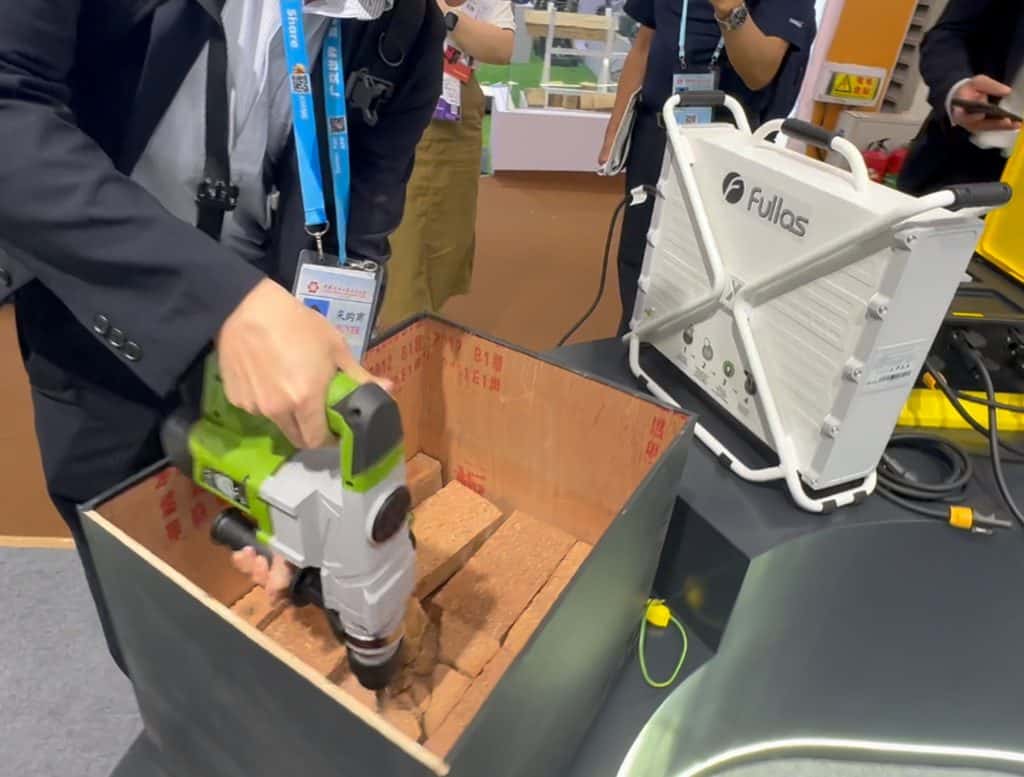
Image suggestion 1:
Insert your Canton Fair live demonstration image here.
Suggested image alt text: Fullas FPG3600 power bank for construction site tool demonstration
Real Construction Tool Test Examples
For construction buyers, real test data is more convincing than general claims. The Fullas FPG3600 has been tested with several types of tools commonly used in construction and job site work.
For example, under 230V conditions, it has been tested with a 3kW arc welding machine, completing 98 welds using 2.5mm welding rods. It has also been tested with a 3.2kW core drilling machine, drilling up to 11 furos with a diameter of 150mm and depth of 150mm.
For drilling work, a 1.4kW drilling tool test showed up to 243 furos with a diameter of 35mm and depth of 10mm. For cutting work, a Serra de corte de 2,7 kW test showed up to 41 cortes on 110mm cast iron pipes.
The FPG3600 was also tested with a Martelo de demolição de 2,2 kW, completing demolition work on 8,2 toneladas de laje de betão. For water pumping applications, a Bomba de 2,3 kW test delivered up to 50.000 litros, with a flow rate of 780 liters per minute and a running time of 64 minutes.
These tests show why high-power portable power stations are becoming more useful for real construction sites.
Power Bank vs Generator for Construction Sites
Fuel generators are still common on construction sites, especially for long outdoor projects. However, a battery power bank can be a better choice in some situations.
A power bank is usually quieter, cleaner, and easier to use indoors. It does not require fuel during operation and does not produce exhaust. OSHA also highlights electrical and generator-related safety concerns on construction sites, which is why safer temporary power planning is important.
A generator may still be better for very long continuous outdoor work where refueling is easier than recharging. But for indoor renovation, urban construction, temporary repair, mobile teams, exhibition setup, and short-to-medium job site tasks, a construction power bank can be more convenient.
The best choice depends on the job. Many contractors may use both: generators for long outdoor work and portable power stations for clean, mobile, and flexible power.
How Much Capacity Do You Need?
The right capacity depends on the tools you use and how long you need to work.
For small tools like drills, lighting, and basic maintenance equipment, a moderate capacity may be enough. For welding, cutting, pumping, and demolition tools, you need a power bank with higher output and stronger peak power.
For example, a 2.3kWh portable power station can support many construction tasks, but the actual runtime depends on the tool power and working pattern. A 2kW tool will consume power faster than a 500W tool. Tools with intermittent use may last longer than tools running continuously.
If the project needs longer operation time, parallel expansion is useful. The FPG3600 supports up to 3 units in parallel, increasing total capacity to 6.9kWh while keeping the system more flexible.
Safety Tips for Using a Power Bank on Construction Sites
A power bank for construction should be used correctly to keep workers and equipment safe.
Do not overload the device beyond its rated load. Always check the power requirement of the tool before connecting. Keep the device away from standing water, heavy impact, and extreme heat. Use proper grounding when needed. Store the product correctly when not in use.
For lithium battery products, long-term storage also matters. If the product will not be used for a long time, it is better to store it with around 60% battery and recharge it at least once every six months. A dry environment around 20°C to 30°C is better for battery life.
For transport, lithium battery products may need to be shipped with lower battery power according to logistics and dangerous goods requirements.
Who Should Use a Construction Power Bank?
A construction power bank is suitable for many professional users, including:
- Contractors working on temporary job sites
- Renovation teams working indoors
- Road repair and maintenance teams
- Utility service teams
- Exhibition and event construction teams
- Emergency repair teams
- Off-grid construction workers
- Mobile workshop operators
It is especially useful when workers need portable, clean, and stable power without setting up a fuel generator.
Considerações finais
The best power bank for construction sites in 2026 should be more than a large battery. It should provide strong output, reliable safety, real tool performance, easy mobility, and practical support for job site problems.
For many contractors, a portable power station can reduce noise, improve flexibility, and provide power in areas where grid electricity is not ready. It can also work as a cleaner alternative to traditional generators in indoor or urban environments.
Fullas FPG3600 is one example of an industrial portable power solution designed for construction-related applications. With 2.3kWh capacity, up to 6.9kWh expansion, CE and UN38.3 certification, factory testing, and real tool test results, it can support many professional job site scenarios.
For construction teams looking for a cleaner, quieter, and more flexible power solution, a heavy-duty portable power bank is becoming a practical choice in 2026.
FAQ
What is the best power bank for construction sites?
The best power bank for construction sites should have high output power, enough battery capacity, safety certification, strong peak power, and proven tool test performance. It should be able to support real construction tools, not only small electronic devices.
Can a power bank run construction tools?
Yes, a high-power portable power station can run many construction tools, such as drills, cutting saws, pumps, vacuum cleaners, and some welding machines. The actual performance depends on the tool’s rated power and starting power.
Is a power bank better than a generator for construction?
A power bank is quieter, cleaner, and easier to use indoors. A generator may be better for very long outdoor work. For many temporary, mobile, indoor, or urban construction tasks, a power bank can be more convenient.
How much battery capacity do I need for construction work?
It depends on the tools and working time. Small tools need less capacity, while welding, cutting, pumping, and demolition tools need higher output and larger battery capacity. A system with expandable capacity is more flexible for different job sites.
Can FPG3600 be used for construction work?
Yes. FPG3600 is suitable for many construction-related applications, including welding, drilling, cutting, pumping, demolition, and temporary job site power supply. It has been tested with several professional tools under real working conditions.